
728 × 90 Banner
The first hybrid powertrain prototype of McLaren Automotive’s breathtaking new Ultimate Series flagship, the McLaren Speedtail, officially embarks this week on a year-long test regime that will underpin the development of the first McLaren Hyper-GT. The punishing test program in the run-up to production commencing at the end of 2019 will see Speedtail prototypes running in Europe, North America and Africa, initially at bespoke automotive test facilities but later amongst traffic on ‘normal’ roads.
Deployment of the first Speedtail attribute prototype marks an exciting new stage in the development of the fastest, most aerodynamic and most luxurious McLaren ever made. The prototype is officially designated MVY02 but echoing the naming of development test mules of its legendary forebear, the 1992 McLaren F1, has been christened, ‘Albert’. This is a respectful reflection not only on the name of the McLaren F1 mule ‘Albert’ but also the Albert Drive premises in which the F1 was designed.
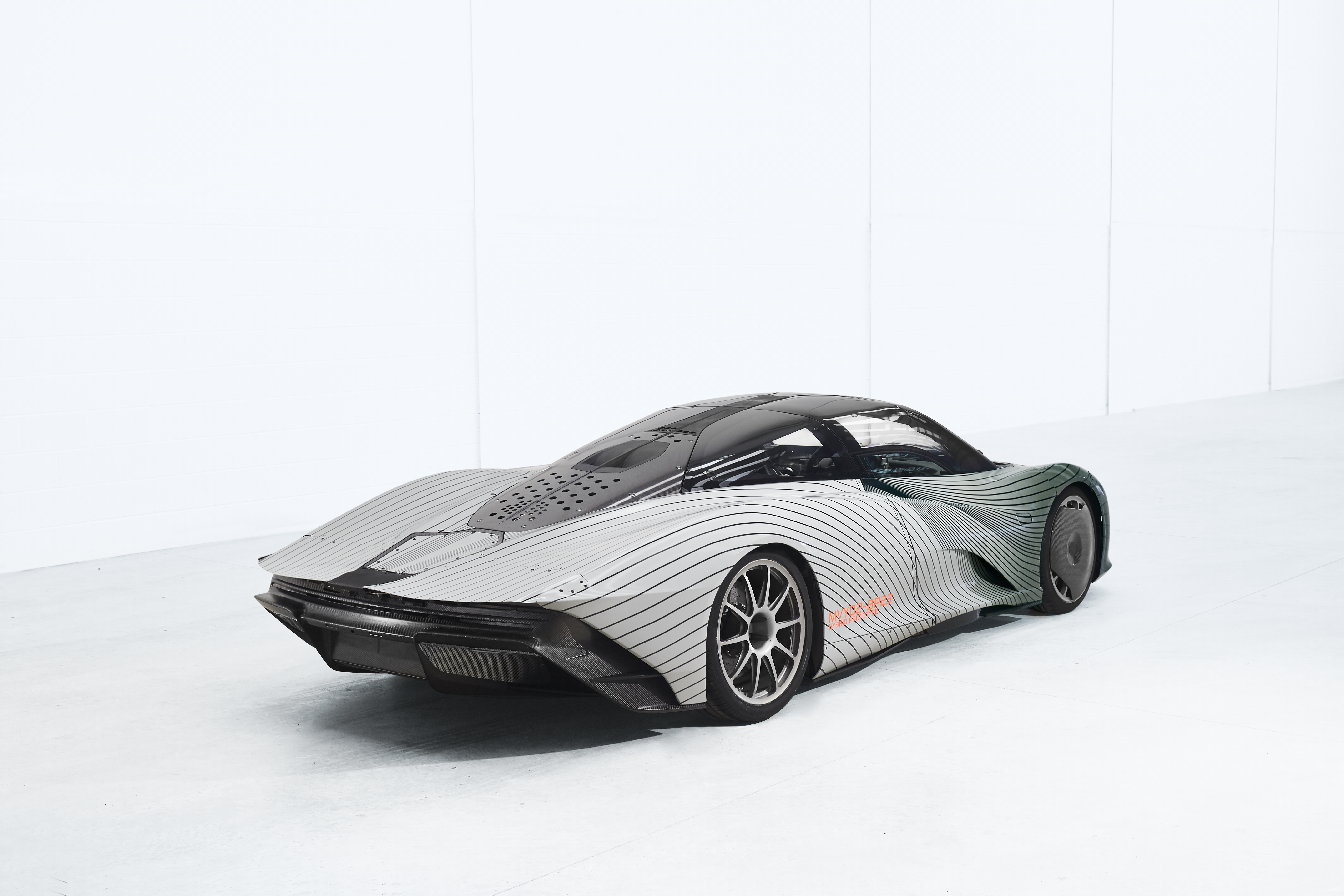
Distinguished by a unique testing livery, ‘Albert’ has a production-specification chassis and petrol-electric hybrid drivetrain, as well as the unique three-seat cockpit with central driving position. As the development and validation program progresses every aspect of the Speedtail’s performance will be honed as the full 1,035bhp available to Speedtail drivers to propel the prototype to 250mph is used – including in high-speed trials with McLaren Automotive Chief Test Driver and former IndyCar champion Kenny Bräck at the wheel.
“The start of real-world testing represents a major step in the development of the McLaren Speedtail. As the first fully representative prototype, ‘Albert’ will build on the invaluable work still being put in by earlier development cars, allowing us to sign-off vehicle attributes including chassis dynamics; brake performance; damper tuning; tires; NVH and aspects of ergonomics and comfort. With a huge amount achieved already, the McLaren Speedtail is well on the way to fulfilling its destiny as the greatest McLaren road car ever.â€
Ben Gulliver, Head of Vehicle Development, McLaren Automotive
The central driving position and three-seat layout of the Speedtail was pioneered by the iconic McLaren F1 in 1992. This configuration is uniquely McLaren, remaining exclusive among production cars until McLaren Automotive confirmed in November 2016 that it would be reprised for the next Ultimate Series model, then codenamed BP23.

The center-seat layout of the Speedtail was first publicly demonstrated in a ‘proof of concept’ model that was simply a McLaren 720S reconfigured with a single, centrally-mounted driving seat. Four further mules followed and these will continue to be used around the world for performance and durability testing, alongside the prototype vehicles.
Despite its test livery and the bodywork from the A-pillars forward, ‘Albert’ is fundamentally a Speedtail, with shape-representative body panels and dihedral doors around the unique carbon fibre McLaren Monocage core structure. The production-level specification allows Speedtail attributes to be proven in real-world conditions early in the development process, including for example ingress and egress to the three-seat cockpit.
Production of the £1.75 million (plus local taxes) McLaren Speedtail is due to commence at the end of 2019, with first deliveries in early 2020. As with the McLaren F1, 106 cars will be available and all have already now been allocated to owners.




Can a plug-in hybrid truly deliver the raw emotion and edge expected from an RS badge? Audi Sport believes the answer is yes, and the all-new Audi RS 5 is its boldest proof yet .
For the first time, the RS 5 pairs a 2.9-liter twin-turbo V6 with a 130 kW electric motor, producing a combined 470 kW (639 PS) . The result is serious performance: 0–100 km/h in just 3.6 seconds and an optional top speed of 285 km/h . Yet it also offers up to 84 kilometers of all-electric range, giving drivers the option to cruise silently through the city before unleashing full hybrid power.

The biggest innovation lies beneath the surface. Audi introduces a world-first electro-mechanical torque vectoring system within its new quattro with Dynamic Torque Control . Torque can be distributed between the rear wheels in milliseconds, enhancing agility, traction, and cornering precision in ways traditional mechanical systems cannot match.

Visually, the RS 5 looks every bit the performance machine, with widened bodywork, a honeycomb Singleframe grille, and an aggressive rear diffuser . Inside, RS-specific digital displays allow drivers to track lap times, G-forces, and hybrid energy flow in real time .
So here’s the real question: has electrification just made the RS formula even stronger?
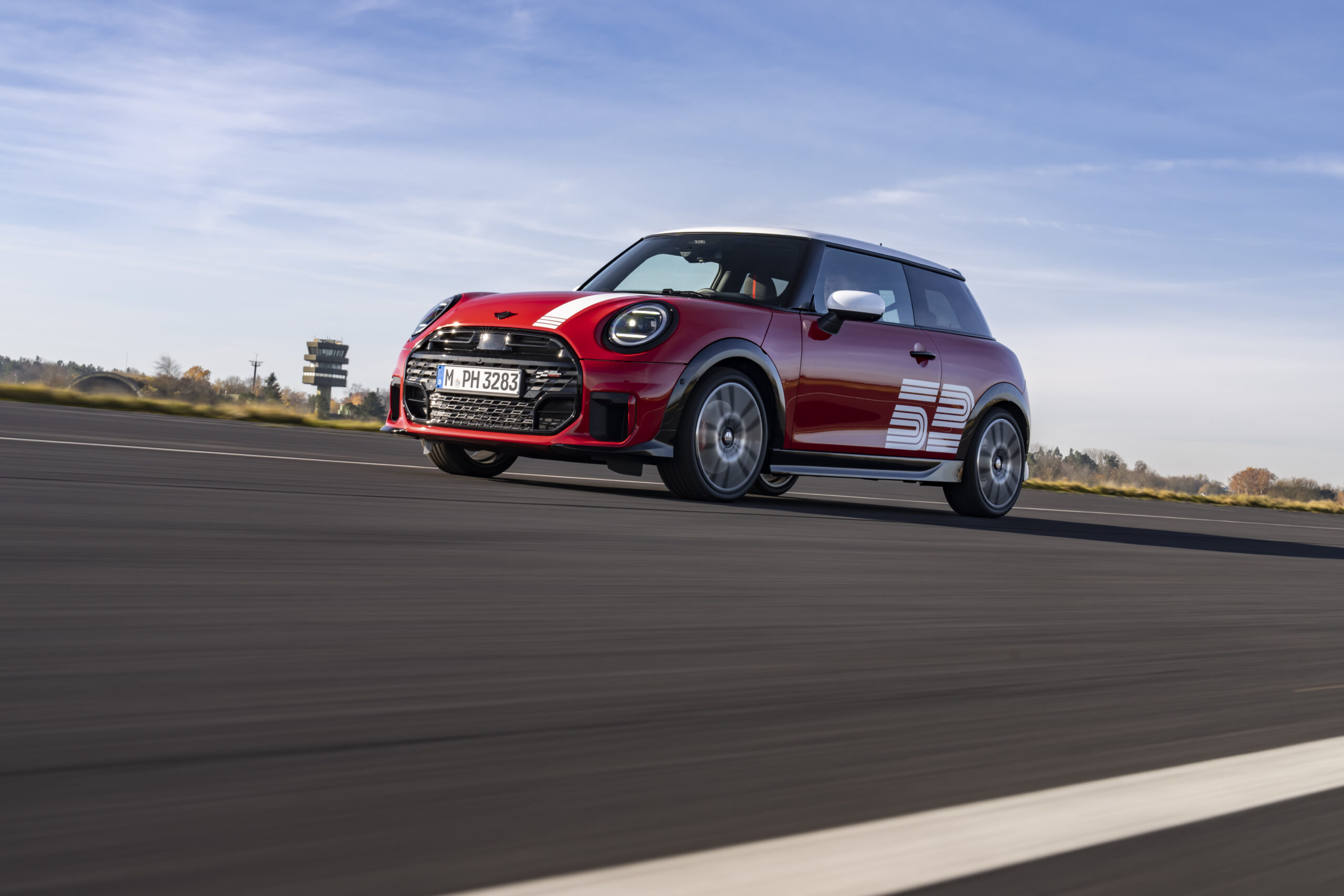
MINI is celebrating one of the most iconic wins in its history with the introduction of the new MINI 1965 Victory Edition. The special model honors the classic Mini Cooper S that triumphed at the 1965 Monte Carlo Rally, where Timo Mäkinen and co-driver Paul Easter showcased the car’s agility, durability, and fearless spirit in extreme winter conditions.

The 1965 Victory Edition blends that heritage with modern performance. While the edition is offered globally across multiple variants, U.S. customers will receive an exclusive version based on the MINI John Cooper Works 2-Door. Powered by a 228-horsepower engine delivering 280 lb-ft of torque, it sprints from 0 to 60 mph in just 6.1 seconds, staying true to the brand’s performance roots.
Visually, the model makes a bold statement. Chili Red paint is paired with a white hood-to-roof stripe and a distinctive white “52” graphic, referencing the original rally car’s competition number. A white panoramic roof, subtle “1965” badging, and 18-inch JCW Lap Spoke two-tone wheels complete the exterior.
Inside, exclusive details including “1965” lettering on the door sills, steering wheel, and key cap serve as constant reminders of MINI’s motorsport legacy. Limited in production, the 1965 Victory Edition arrives in March 2026 starting at $46,220 plus destination.
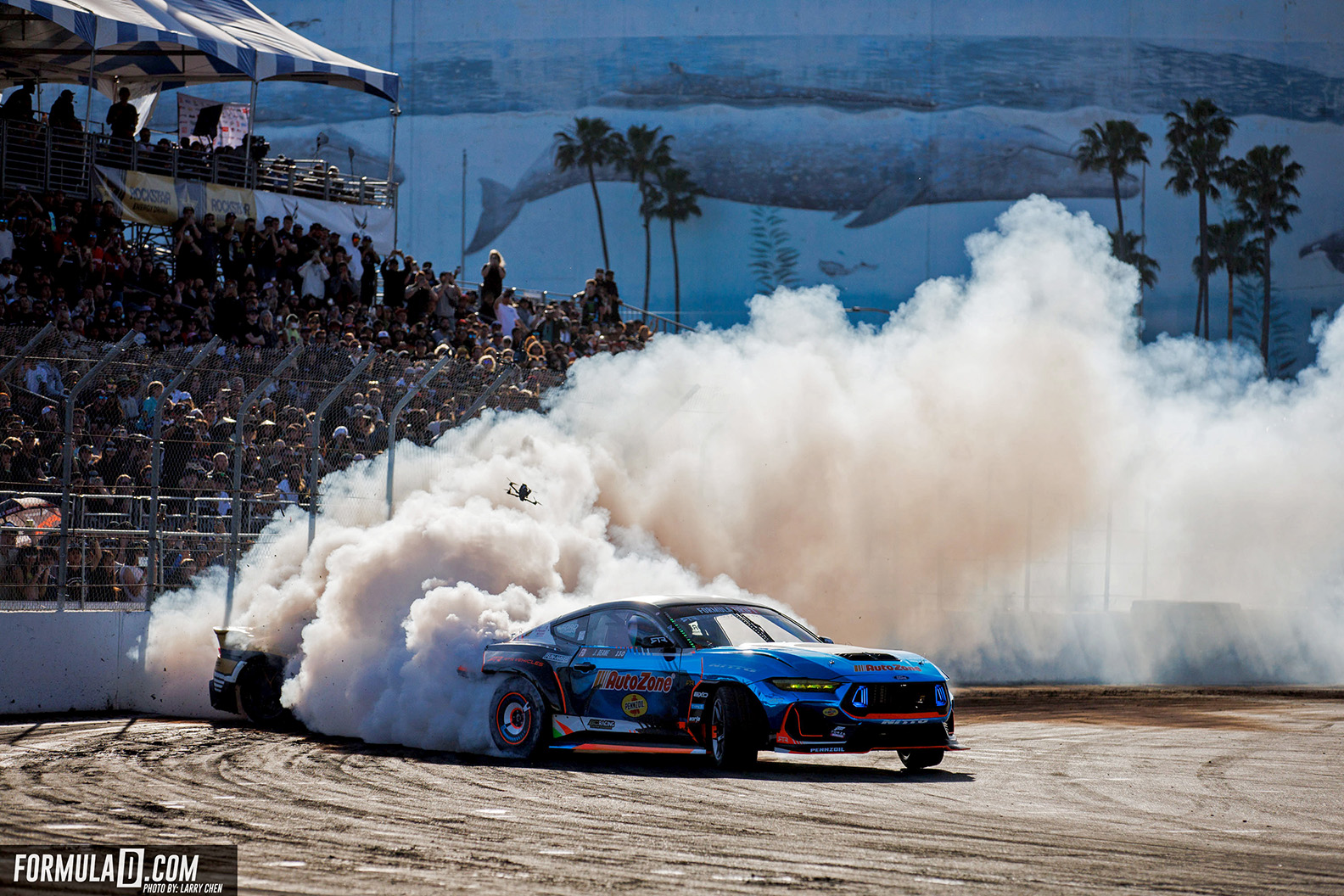
Formula DRIFT is set to make the biggest change in its history as the 2026 season introduces a groundbreaking digital scoring system in partnership with Race Data Labs. The move will reshape qualifying in the FD PRO Championship while enhancing competition across both PRO and PROSPEC divisions.
After two seasons of the All-Tandem Qualifying format, drivers were surveyed during dedicated summits. The majority of PRO drivers voted to remove the All-Tandem Seeding Bracket format and return to Two-Run Qualifying. Meanwhile, PROSPEC competitors chose to retain Seeding Bracket Qualifying due to its positive impact on driver development.

The solution comes through Race Data Labs’ Universal Drift Scoring Method system. Approximately 80 percent of a PRO driver’s qualifying score will now be automated. Drift line and angle will be measured objectively through telemetry, while the remaining 20 percent, focused on driving style, will still be judged by Formula DRIFT’s three-judge panel.
Beyond qualifying, the telemetry system will assist judges during tandem battles by analyzing proximity, speed, angle, deceleration, and off-course violations. It will even help clarify fault in collision scenarios.
Fans will also benefit, as live telemetry data will be integrated into free livestream broadcasts beginning with the Long Beach season opener on April 10-11.
-
 INTELLIGENT MOBILITY7 months ago
Customers Demand a Manual Honda Prelude: Will It Ever Happen?
-
 TEST DRIVES3 weeks ago
2025 Ford Maverick Lobo
-
 INTELLIGENT MOBILITY7 months ago
10,000 RPM Madness: The Honda S2000 Resurrected with 580 HP and a Supercharged Heart
-
 INTELLIGENT MOBILITY7 months ago
FIFA World Cup 2026: The Importance of Electric Vehicles
-
 INTELLIGENT MOBILITY7 months ago
BYD Atto 8: The New 7-Seater PHEV SUV Arrives in Mexico
-
 INTELLIGENT MOBILITY7 months ago
New Dodge Charger Hustle Stuff Drag Pack 2025: The Wild Return of the Hemi V8
-
 INTELLIGENT MOBILITY7 months ago
Kia Sportage 2026: Safety Excellence Crowned with IIHS TOP SAFETY PICK+ Award
-
 INTELLIGENT MOBILITY7 months ago
Kia America Achieves Record-Breaking October 2025 Sales
You must be logged in to post a comment Login