
EVENTS
Rolls-Royce Silver Ghost: 120 Years of Defining Luxury

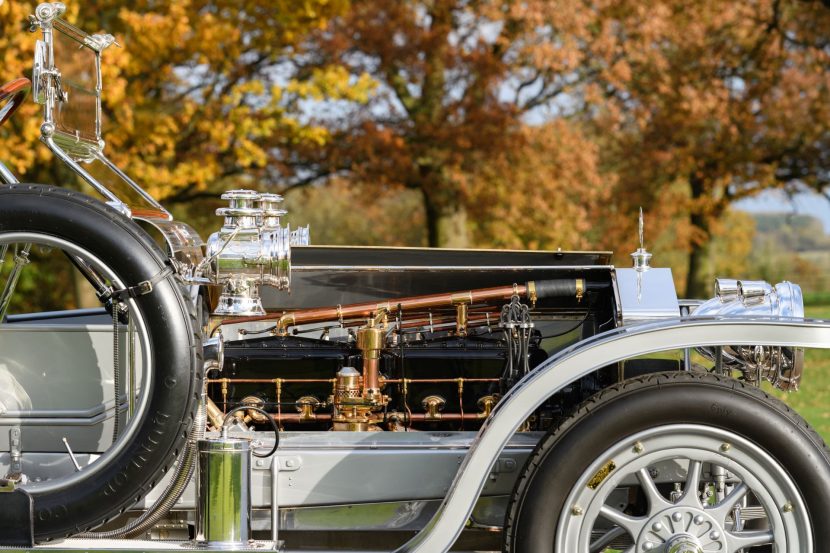
How a remarkable automobile introduced in 1906 established a standard of engineering, refinement, and prestige that continues to shape Rolls-Royce today.

Luxury is often measured by what an automobile offers. The finest materials, the most advanced technology, the quietest cabin, or the prestige of a particular badge. But long before these became familiar measures of automotive excellence, one automobile helped establish the expectations behind them.
In 1906, Rolls-Royce introduced the 40/50 H.P., a motor car that would become known around the world as the Silver Ghost. At a time when automobiles were still temperamental machines, its exceptional smoothness, engineering precision, and dependability offered something extraordinary: the confidence that luxury could be as reliable as it was beautiful.
One hundred and twenty years later, the Silver Ghost remains more than an important chapter in British automotive history. It represents the beginning of a philosophy that continues to define Rolls-Royce Motor Cars.
The Birth of an Extraordinary Automobile
When the 40/50 H.P. made its debut at London’s Olympia Motor Show in November 1906, the automotive industry was still finding its identity. Mechanical failures were common, long-distance travel could be unpredictable, and comfort was often secondary to the simple achievement of reaching a destination.
Henry Royce approached these challenges with an engineer’s determination to eliminate imperfections. His six-cylinder engine was designed for exceptional smoothness, while meticulous attention to mechanical components, handling, and refinement elevated the automobile beyond the expectations of its era.
Yet engineering alone would not create the Silver Ghost legend.
Claude Johnson, Rolls-Royce’s first Commercial Managing Director, understood that exceptional machinery needed an equally compelling identity. He selected chassis 60551, finished in distinctive silver paint with silver-plated fittings, and named it The Silver Ghost.
The name originally belonged to that particular automobile. Its reputation became so influential that owners began using Silver Ghost to describe other Rolls-Royce 40/50 H.P. models. Eventually, the designation became synonymous with the entire series.
It was an early example of how engineering excellence and brand identity could reinforce one another.
When Excellence Had to Be Proven

Today, luxury manufacturers demonstrate their capabilities through sophisticated technology, extensive testing, and increasingly ambitious performance figures. In the early twentieth century, Rolls-Royce had to prove its reputation under considerably less forgiving conditions.
The Silver Ghost participated in demanding endurance events, including the Scottish Reliability Trial, the London–Edinburgh Trial, and the Austrian Alpine Trial.
Among its most remarkable achievements was the performance of chassis 1701, nicknamed The Sluggard.
In 1911, driven by Rolls-Royce experimental test driver Ernest Hives, the automobile completed the London–Edinburgh Trial with its gearbox deliberately locked in top gear. The achievement demonstrated extraordinary mechanical flexibility and dependability at a time when such capabilities could hardly be taken for granted.
Its performance was equally impressive. During the trial, the car achieved fuel consumption exceeding 24 miles per gallon. Later that year, fitted with streamlined coachwork, it reached 101.8 mph at Brooklands, becoming the first Rolls-Royce to exceed 100 mph.
These accomplishments were not simply publicity exercises. They provided tangible evidence that a luxury automobile could deliver refinement, endurance, and serious performance without compromising its fundamental character.
The message was clear: Rolls-Royce was building automobiles engineered to earn their reputation.
The Automobile That Captured the World’s Attention
The Silver Ghost’s appeal extended far beyond engineering enthusiasts.
Its owners included prominent figures in business, politics, aviation, and the arts. Winston Churchill, Howard Hughes, financier Baron Alfred de Rothschild, and aviation pioneer Tommy Sopwith were among those associated with the model.
For these individuals, the automobile represented more than transportation. It offered prestige, discretion, comfort, and the freedom to travel with confidence.
Opera singer Dame Nellie Melba took delivery of her 1911 Silver Ghost at London’s Ritz Hotel. She subsequently used the automobile across Britain, France, and Australia, relying on its comfort and dependability during extensive travels.
Another owner, Charles H. Angas of Australia, affectionately named his Silver Ghost The Dreamer because his wife regularly fell asleep during journeys.
It is a charming detail, but also a revealing one.
At a time when automobile travel could be noisy, uncomfortable, and exhausting, the ability to relax so completely inside a motor car was itself a remarkable expression of luxury.
The Silver Ghost had achieved something that remains essential to the Rolls-Royce experience: making extraordinary engineering feel effortless.
More Than a Motor Car, a Symbol of Prestige

The Silver Ghost also played a role in establishing one of the most recognizable symbols in automotive history.
Lord Montagu of Beaulieu’s Silver Ghost became the first motor car to carry the Spirit of Ecstasy, the sculpture created by Charles Sykes and introduced as the official Rolls-Royce mascot in 1911.
Over the following decades, the graceful figure would become inseparable from the marque’s identity.
The Silver Ghost’s reputation also reached royal households. In 1911, the Government of India ordered eight landaulette-bodied examples for celebrations associated with the visit of King George V and Queen Mary. Rolls-Royce supplied drivers for the occasion, reinforcing the confidence placed in the brand for events of exceptional importance.
Such associations helped transform Rolls-Royce from a manufacturer of prestigious automobiles into a lasting symbol of distinction.
But its reputation was never based solely on the prominence of its clientele. The Silver Ghost had already demonstrated the mechanical substance behind its status.
That combination of credibility and exclusivity proved extraordinarily powerful.
A Legacy That Refuses to Fade
Many historic automobiles are admired primarily as museum pieces. The Silver Ghost offers a different perspective.
Production of the 40/50 H.P. continued until 1925, with 6,173 examples built in Britain and another 1,703 manufactured at Rolls-Royce’s American factory in Springfield, Massachusetts.
More than a century later, surviving examples continue to demonstrate the durability of their original engineering.
In 2013, 47 Silver Ghosts retraced the approximately 1,800-mile route of the 1913 Alpine Trial. Among them was chassis 1701, the same automobile that had achieved its remarkable London–Edinburgh performance in 1911.
In 2021, chassis 1701 repeated the London–Edinburgh journey with its gearbox once again locked in top gear, recreating the challenge it had completed 110 years earlier.
Few demonstrations of automotive heritage are more convincing than a century-old machine continuing to perform the work for which it was originally designed.
Today, chassis 1701 is displayed at the Home of Rolls-Royce in Goodwood, England, where it represents a direct connection between the company’s earliest engineering ambitions and its modern identity.
The Meaning of Luxury, 120 Years Later

The automotive world of 2026 would be almost unrecognizable to Henry Royce.
Electric propulsion, advanced electronics, sophisticated manufacturing, and an extraordinary degree of personalization have transformed what luxury automobiles can offer.
Yet the principles that made the Silver Ghost exceptional remain remarkably relevant.
A modern Rolls-Royce is expected to deliver effortless performance, exceptional refinement, meticulous craftsmanship, and a sense of occasion that transcends conventional transportation.
Whether expressed through the commanding presence of the Phantom, the contemporary elegance of the Ghost, or the electric sophistication of the Spectre, the objective remains connected to the ideals established in 1906.
Technology changes. Expectations evolve. The pursuit of excellence remains.
As Andrew Ball, Head of Corporate Communications and Heritage at Rolls-Royce Motor Cars, observes, the Silver Ghost established expectations of refinement, reliability, and excellence that continue to define the marque.
There is something particularly compelling about that continuity.
In an industry increasingly defined by rapid technological transformation, Rolls-Royce’s greatest asset may be its ability to evolve without abandoning the qualities that established its reputation.
The Silver Ghost did not simply introduce a new standard for luxury automobiles. It helped create the expectations by which generations of exceptional motor cars would be judged.
And 120 years later, that may be its most enduring achievement.


-
 NOW TRENDING2 months ago
Aston Martin DBX Becomes Harry Da Souza’s Ride in MobLand
-
 TEST DRIVES2 months ago
2026 Maserati GranTurismo Trofeo Review: Miami
-
 INTELLIGENT MOBILITY2 months ago
Tesla Cybercab Navigation Problem Hits Austin Robotaxis
-
 INTELLIGENT MOBILITY2 months ago
2027 Nissan Rogue Hybrid: e-POWER Comes to America
-

 TEST DRIVES2 months ago
2026 Maserati GranTurismo Coupe
-
 Formula12 months ago
Cadillac F1 2026 Faces an Eight-Race Logistics Challenge
-
 NOW TRENDING2 months ago
Land Rover Defender Recall 2026: 23,677 JLR SUVs Affected
-
 NOW TRENDING2 months ago
Every 2026 Chevrolet With AWD or 4WD