
Formula1
F1 2026 Driving Style: Why Norris Rejects Russell’s Theory

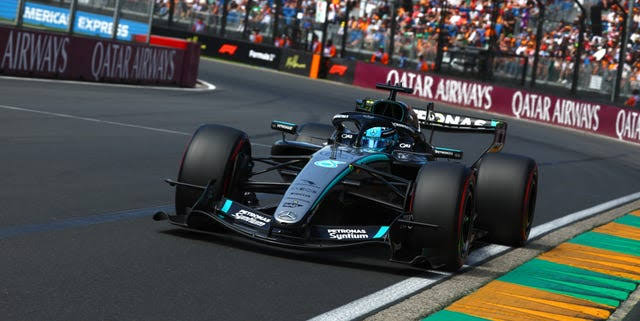
George Russell believes the 2026 cars favour a specific driving style, but Lando Norris argues that adaptability matters more than using one particular technique.
Russell sees a clear pattern in F1 2026
The F1 2026 driving style debate has become one of the most interesting technical discussions of the new regulations. George Russell believes the current cars reward certain techniques, while others can lose performance because of how energy is deployed.
The new generation of Formula 1 cars relies heavily on electrical energy management. Small differences in how drivers use the controls can therefore affect the amount of energy available later on a lap.
That can become especially important on long straights.
A driver with less available electrical energy may receive less assistance on the straight. The same driver can also reach the system’s ramp-down phase, often called the “staircase”, earlier.
This can create differences between teammates that are difficult to explain by looking only at lap times.

Russell believes these characteristics explain part of his early-season struggles against Kimi Antonelli.
The Mercedes driver has been working on changing his driving approach. He says the process is difficult because it requires him to modify techniques he has developed over many years.
Russell believes that adapting to the 2026 cars requires a fundamental change in how a driver works with the car.
He has also noticed similar patterns elsewhere on the grid.
According to Russell, the gap between teammates has changed compared with previous seasons. He points to Mercedes, McLaren and Red Bull as examples.
The differences are particularly interesting because the cars themselves are extremely complex.
The driver must manage braking, acceleration, cornering and energy deployment at the same time. As a result, finding the fastest lap can require actions that feel unnatural behind the wheel.
Norris believes adaptability is the real advantage
Lando Norris does not completely agree with Russell’s explanation.
The McLaren driver argues that there is no single driving style that automatically works with the 2026 cars.
Norris believes his main strength is his ability to adapt to different cars. He says his own driving style does not naturally suit the current generation either.
Instead, he changes his technique to extract performance from whatever car he is driving.
That distinction is important.

Norris also points to his experience from previous seasons.
In 2025, he said the McLaren initially suited Oscar Piastri better. Norris then adapted his driving to the characteristics of the car.
That process helped him become more comfortable with the MCL38 as the season progressed.
He sees a similar situation in 2026.
Norris argues that the key skill is not having the perfect style, but being able to change that style when the car demands it.
That is why he rejects the idea that the 2026 cars simply favour one type of driver.
He also says the current cars are fundamentally different from last year’s machines.
The energy systems and aerodynamic rules have changed. Drivers therefore have to learn new techniques to manage the car effectively.
Norris believes that process is part of the job.
Energy management changes how drivers attack corners
The technical side of the discussion explains why this debate exists.
Modern F1 drivers do not simply brake as late as possible and accelerate as early as possible.
With the 2026 power-unit regulations, energy management plays a bigger role. Drivers must consider how much electrical energy they have available and where they will need it later in the lap.
That can change the ideal way to approach a corner.
A faster corner entry is not always the fastest overall solution. A different throttle position can also influence how the car manages its energy.

This creates what Russell describes as a counterintuitive driving style.
The driver may need to avoid certain actions that normally produce a faster corner.
The ideal lap can therefore involve precise control inputs. Throttle position becomes particularly important.
The same applies to braking and steering.
A driver who understands those relationships can potentially extract more performance from the available energy. Another driver may lose time without immediately understanding why.
The effect becomes easier to notice on circuits with long straights.
If one driver reaches the straight with less electrical energy available, the difference can appear as lower top speed. That can then affect the rest of the lap.
Russell and Norris have different approaches
There are also differences between Russell and Norris themselves.
Russell believes he has had to make a fundamental change to his technique. He says he has made progress since the summer break and is now more comfortable with the requirements of the Mercedes.
Norris takes a different view.
He believes adaptability is more important than having a specific style that naturally suits the car.
That does not mean driving technique is irrelevant.
Instead, it suggests that the driver-car relationship changes from one season to another.
Norris also points to Oscar Piastri.
The two McLaren drivers have similarities in how they separate braking and cornering phases. However, Norris says each driver still has to adapt to the specific behaviour of the car.
That creates an interesting contrast with Russell’s theory.
The 2026 regulations have changed the equation
The new regulations have increased the importance of energy management.
Drivers must now think about more than mechanical grip and aerodynamic balance. Electrical deployment can influence how a car behaves later in the lap, particularly when the battery state changes.
That makes preparation in the simulator even more important.
Teams have limited opportunities to test these characteristics on track. Much of the learning therefore happens before a Grand Prix.
Drivers can then use practice sessions to test different techniques.
Russell has described that process as difficult because changing a deeply established driving habit takes time.
Norris, meanwhile, sees adaptability as a core part of being a Formula 1 driver.
The debate also helps explain why some teammate gaps have looked unusual during 2026.
Drivers with similar machinery can produce different results. Their approaches to energy management, throttle use and corner entry can influence the final performance.
The 2026 cars have not eliminated the importance of the driver. They have simply changed the ways in which the driver can extract performance.
For Russell, that means learning a new way to work with the Mercedes.
For Norris, the lesson is slightly different.
He believes there is no perfect driving style for these cars. Instead, the driver who can understand the car and adjust his technique has another important tool.
That difference in philosophy is why Norris has challenged Russell’s theory.
And the discussion is unlikely to end soon.
As teams continue to understand the 2026 regulations, drivers will keep refining their techniques. More data should also reveal which aspects of driving style have the greatest effect on energy deployment.
For now, Russell sees a clear pattern, while Norris places greater emphasis on adaptability.
Both approaches highlight how dramatically the new technical rules have changed the way Formula 1 drivers approach a lap.








-

 NOW TRENDING2 months ago
Aston Martin DBX Becomes Harry Da Souza’s Ride in MobLand
-

 TEST DRIVES2 months ago
2026 Maserati GranTurismo Trofeo Review: Miami
-
 INTELLIGENT MOBILITY2 months ago
Tesla Cybercab Navigation Problem Hits Austin Robotaxis
-
 INTELLIGENT MOBILITY2 months ago
Tesla Cybercab Cannot Be Charged at Home—Here’s Why
-
 INTELLIGENT MOBILITY2 months ago
2027 Nissan Rogue Hybrid: e-POWER Comes to America
-

 TEST DRIVES2 months ago
2026 Maserati GranTurismo Coupe
-
 Formula12 months ago
Cadillac F1 2026 Faces an Eight-Race Logistics Challenge
-

 NOW TRENDING2 months ago
2027 Lexus LS Gets Another Update, But Not in America