
INTELLIGENT MOBILITY
2027 Ford Fathom Home Power: What Buyers Need to Budget

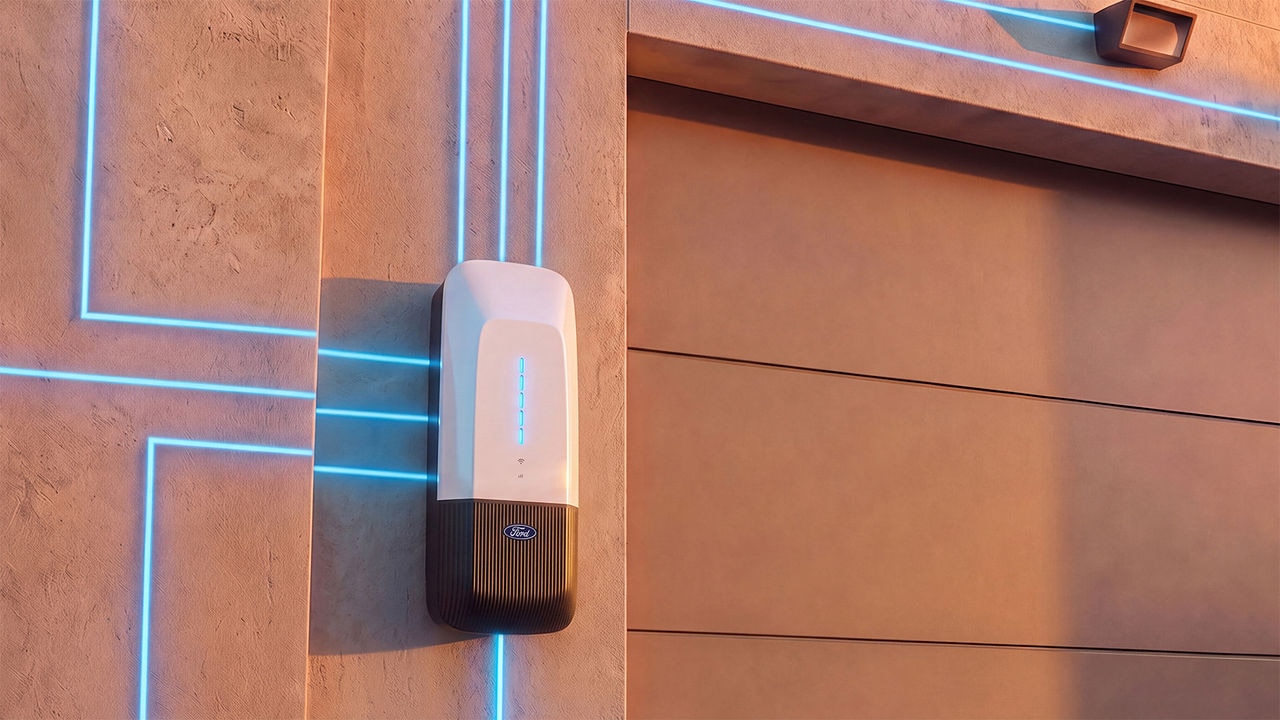
Ford’s new home-power announcement adds a second buying decision to its upcoming electric pickup: what it will cost to connect the truck to a house, and whether the owner’s electricity rates justify that investment.

Ford’s illustration shows the planned home-power equipment. Vehicle pricing does not include a complete home installation. Credit: Ford Motor Company.
Ford plans to offer its Fathom electric pickup with available bidirectional AC power when it arrives in 2027. In an October 27 announcement, the company projected output above 10 kW and said the system would supply a home without a separate wall-mounted inverter. Buyers would still need compatible home equipment.
That distinction matters. The pickup’s advertised price covers the vehicle; using its battery to manage household electricity introduces equipment, installation and operating costs that deserve a separate budget.
Start with the truck price, then price the house
Ford’s current U.S. product page lists a $28,350 starting MSRP with the standard-range battery, plus $1,595 for destination and delivery. Together, those figures total $29,945 before taxes, registration, dealer documentation fees and any options.
That leaves just $55 below $30,000. A buyer using that figure as a combined vehicle-and-home-energy budget has effectively used it up before accounting for the home installation.
Ford says preorders will open in early 2027. Its product page also says projected EPA driving-range figures are not yet available. The purchase calculation therefore still needs details about the truck as well as the house.
Carsfera previously reported on the Ford Fathom’s pricing and manufacturing strategy, providing details about the broader vehicle program. This week’s announcement adds new information about the equipment and utility requirements for its home-power capability.
Electricity savings and outage backup need different equipment
Ford describes two uses. Home Power Management shifts electricity purchases toward cheaper hours, then supplies the house when rates rise. It requires the Ford Home Power Station, utility approval and an active trial or plan.
Home Backup Power supplies the house during an outage. Ford says that setup requires both the Home Power Station and Home Backup Power Panel, and may require utility notice or approval.
The company expects the station to cost about half as much as its first-generation bidirectional charger. It also projects a reduction of at least 60% for the referenced home-backup hardware. Those are equipment comparisons, not a quote for an installed system at a particular address.
Ask for an itemized proposal that separates equipment, installation, any electrical upgrades and ongoing service charges. That makes it possible to compare the two functions without assuming they have the same entry cost.
Why moving the inverter matters
In a separate technical announcement, Ford explains that the inverter is integrated into the vehicle’s E-box. The truck can therefore deliver AC electricity to the house rather than relying on a separate external inverter for that conversion.

Ford identifies this as the Fathom’s E-box, which integrates the inverter used to supply AC power to a properly equipped home. Credit: Ford Motor Company.
Ford is also working with utilities on the connection process. Its working group, formed in July 2026, includes American Electric Power, Consumers Energy, Exelon and Pacific Gas and Electric, alongside Canada’s BC Hydro.
For a U.S. buyer, the practical question is whether the local utility supports the intended use at the home address. Participation by a utility in a development group does not, by itself, establish a customer’s eligibility or an approved installation date.
More than 10 kW does not specify backup duration
Power and stored energy answer different questions. Kilowatts describe the rate at which electricity is supplied; kilowatt-hours describe an amount of energy. The Department of Energy uses that distinction in its charging guidance.
Ford’s projected output does not establish how long a particular house could run. That calculation also needs the energy available for home use, household demand, conversion losses and the battery reserve retained for driving.
For example, an assumed 20 kWh delivered to household circuits would cover a steady 2 kW load for ten hours, or a 5 kW load for four hours. This is arithmetic illustrating the difference, not a Fathom battery specification or a runtime claim. The truck also needs to be home and connected when that energy is required.
Carsfera’s calculation: test the electricity-rate gap
The Department of Energy notes that some utilities offer time-of-use rates. Those local prices are the starting point for testing the bill-saving case.
Consider a hypothetical household that shifts 10 kWh of consumption away from a peak rate of $0.30 per kWh. Assume off-peak electricity costs $0.12 per kWh and that 80% of the electricity purchased for this cycle ultimately reaches the home after losses. That efficiency is an illustrative assumption, not a Ford measurement.
The calculation is:
- Peak electricity purchases avoided: 10 kWh × $0.30 = $3.00.
- Off-peak electricity needed: 10 kWh ÷ 0.80 = 12.5 kWh.
- Off-peak purchase cost: 12.5 kWh × $0.12 = $1.50.
- Difference: $1.50 per operating day, or $375 over 250 such days.
That $375 is an energy-cost difference before equipment, installation, plan fees, financing and battery wear. It assumes the vehicle is available for every modeled cycle. With the same $0.12 rate at both times, the cycle would instead cost $0.30 more because of the assumed losses.
Before ordering home equipment, request two written figures: the fully installed price and an annual savings estimate using the actual utility tariff and driving schedule. Require the estimate to show losses and recurring fees. If the main goal is outage protection, request a separate calculation of the circuits supported and the driving reserve retained. Those numbers let the buyer put a value on each function before paying for both.








-

 NOW TRENDING2 months ago
Aston Martin DBX Becomes Harry Da Souza’s Ride in MobLand
-
 TEST DRIVES2 months ago
2026 Maserati GranTurismo Trofeo Review: Miami
-
 INTELLIGENT MOBILITY2 months ago
Tesla Cybercab Navigation Problem Hits Austin Robotaxis
-
 INTELLIGENT MOBILITY2 months ago
2027 Nissan Rogue Hybrid: e-POWER Comes to America
-
 TEST DRIVES2 months ago
2026 Maserati GranTurismo Coupe
-

 Formula12 months ago
Cadillac F1 2026 Faces an Eight-Race Logistics Challenge
-

 NOW TRENDING2 months ago
Land Rover Defender Recall 2026: 23,677 JLR SUVs Affected
-
 NOW TRENDING2 months ago
Every 2026 Chevrolet With AWD or 4WD