
NOW TRENDING
2027 Subaru WRX GD25 and BRZ ZC15 Go Manual-Only

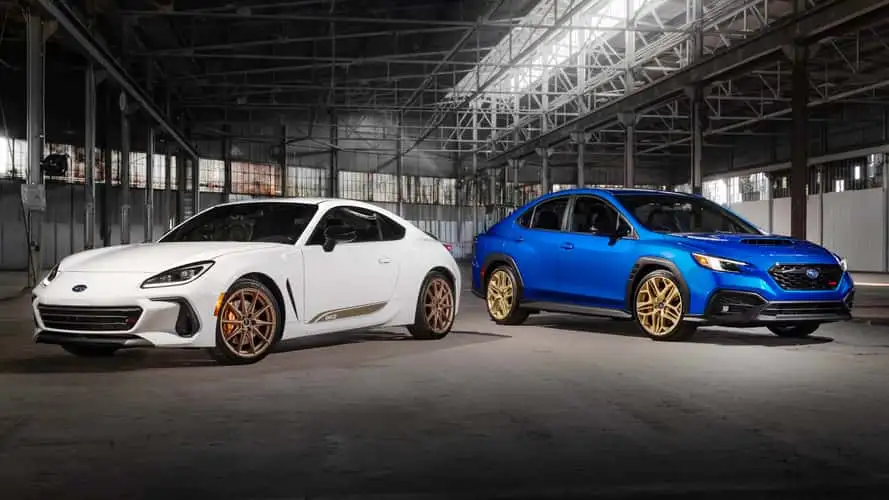
Subaru is celebrating 25 years of the WRX in America and 15 years of the BRZ with two limited-production, manual-only special editions for 2027.
Subaru brings back two enthusiast-focused editions
Subaru has unveiled the 2027 WRX GD25 and 2027 BRZ ZC15 at Boxerfest 2026 in York, Pennsylvania.
Both models celebrate important milestones in the U.S. The WRX marks 25 years in America, while the BRZ reaches 15 years. Their names also reference the original chassis codes.
Production will be limited to 350 WRX GD25 units and 300 BRZ ZC15 units. Subaru also confirms that both editions will use a six-speed manual transmission.
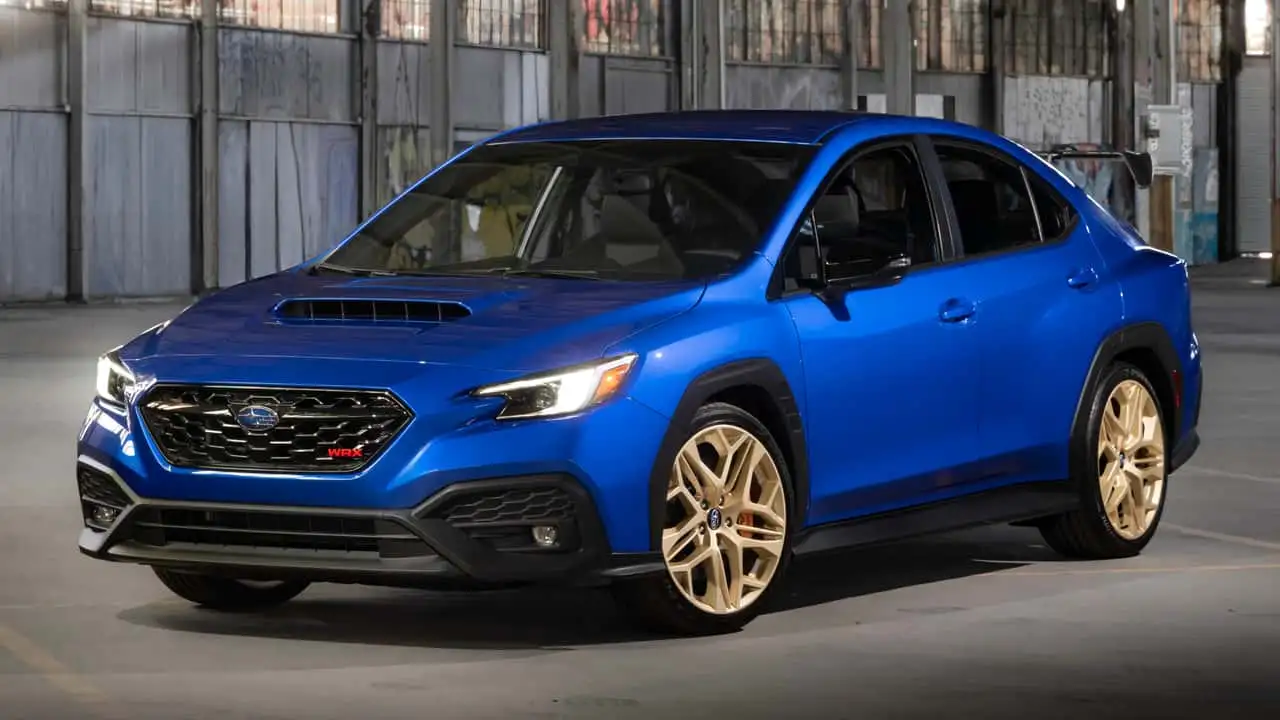
The WRX GD25 combines World Rally Blue paint, gold wheels and a large carbon-fiber rear wing.
2027 Subaru WRX GD25
The WRX GD25 is finished exclusively in World Rally Blue.
It also gets gold 19-inch wheels, upgraded Brembo brakes and Bridgestone Potenza S007 tires. Subaru adds stiffer springs and revised damping to sharpen the chassis.
The standout feature is the rear wing.
It is a dry-carbon-fiber swan-neck wing from Subaru Tecnica International, the same component used on Travis Pastrana’s WRX ARA25L rally car. A flexible strut tower bar adds more rigidity at the front.
The engine remains familiar.
The GD25 uses a 2.4-liter turbocharged SUBARU BOXER engine with 271 horsepower. Power goes through a six-speed manual transmission with an STI short shifter and Subaru Symmetrical All-Wheel Drive.
Inside, Subaru adds Recaro seats with black Ultrasuede and red stitching, plus an STI shift knob.
2027 Subaru BRZ ZC15
The BRZ receives a different visual treatment.
The ZC15 comes exclusively in Ceramic White. It uses matte bronze wheels, red Brembo calipers and bronze side decals. Subaru also adds a black decklid spoiler.
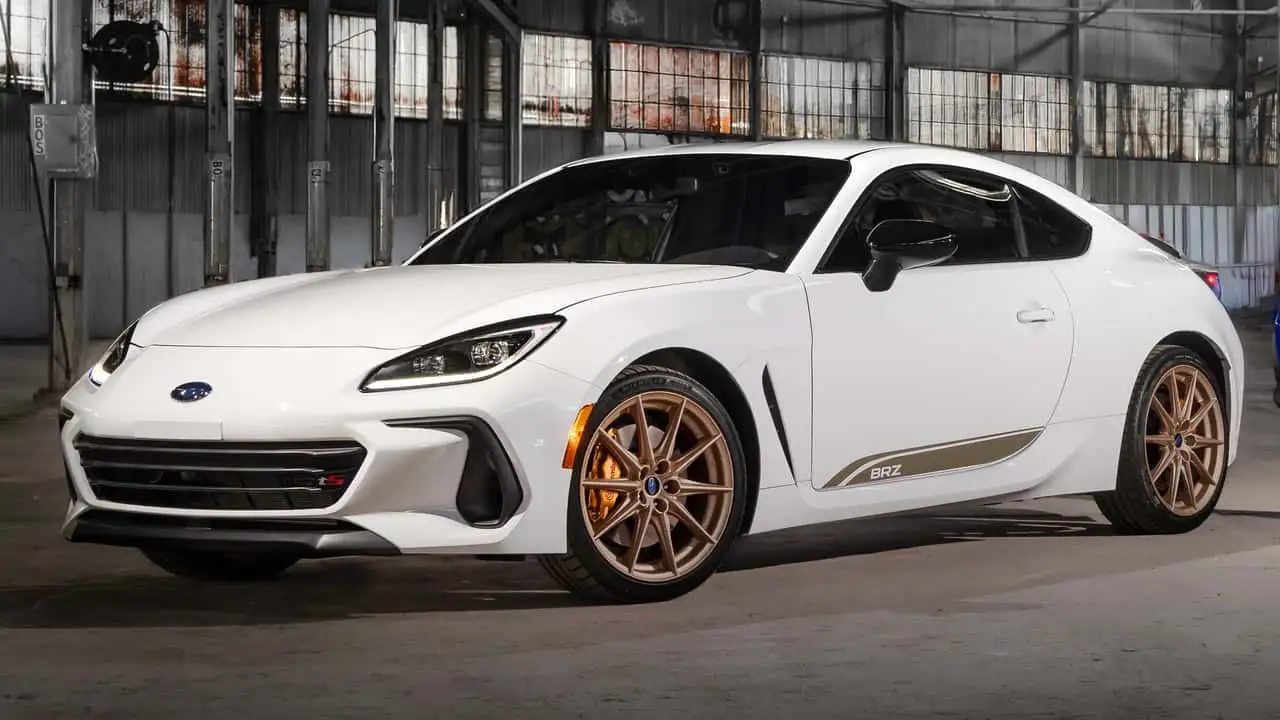
The BRZ ZC15 uses a Ceramic White body, bronze wheels and a black rear spoiler.
The mechanical package is also upgraded.
A flexible V-bar adds chassis rigidity. The car keeps its 2.4-liter naturally aspirated BOXER engine, producing 228 horsepower and 184 lb-ft of torque.
The six-speed manual is the only transmission. Power goes exclusively to the rear wheels, preserving the BRZ’s traditional sports-car layout.
The interior gets black leather-appointed upholstery with Bordeaux Red inserts. Subaru also adds a unique ZC15 anniversary plaque and an STI short shifter.
Two special editions with the same idea
The WRX and BRZ take different approaches, but the formula is similar.
Both receive heritage-inspired colors, performance hardware and manual transmissions. Both are also limited to a small production run.
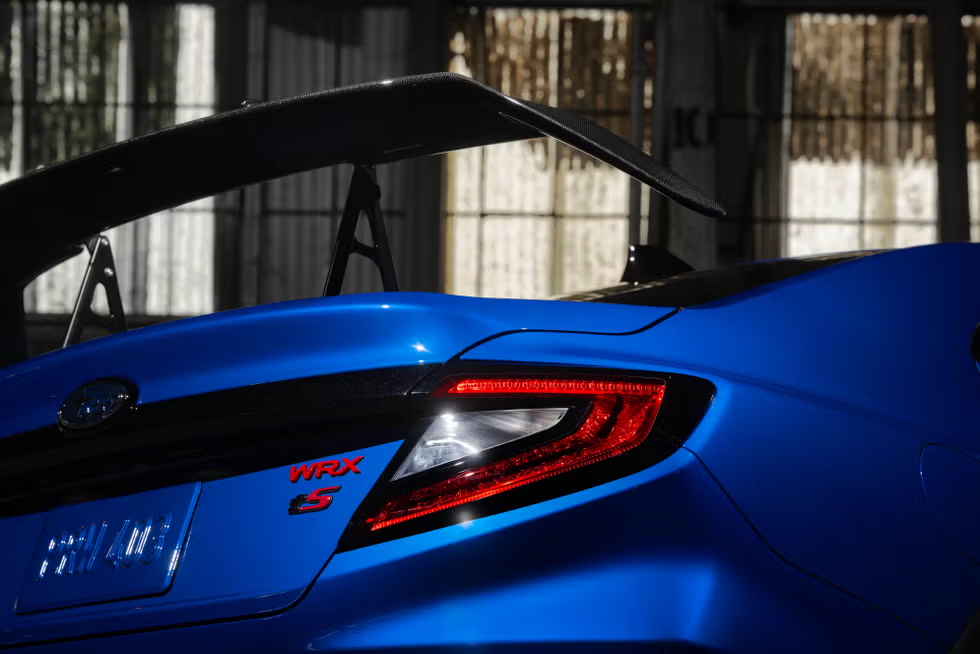
The two special editions connect Subaru’s current performance cars with their history in the U.S.
Subaru expects the BRZ ZC15 to arrive in early 2027.
The WRX GD25 is scheduled for summer 2027. Pricing will be announced closer to each model’s launch.
For U.S. enthusiasts, these editions offer something increasingly uncommon: small-production performance cars with manual transmissions and dedicated hardware.
The 2027 Subaru WRX GD25 and BRZ ZC15 will be built in very limited numbers, with the WRX capped at 350 units and the BRZ at 300.









Production challenges could leave American buyers waiting months for Volvo’s new electric SUV.
The Volvo EX60 could remain difficult to find in the United States until the second half of 2027, as manufacturing problems threaten to slow the launch of one of the brand’s most important new electric vehicles. Although a limited number of 2027 models have already reached the country, most American buyers could face a significantly longer wait.
The potential delay comes at a critical time for Volvo. The Swedish automaker aims to reach 200,000 annual retail sales in the United States by 2030, and the EX60 is expected to play a major role in that strategy. However, production constraints could limit the SUV’s contribution just as Volvo prepares to compete more aggressively in the premium electric vehicle market.
Volvo EX60 Production Delays Could Limit U.S. Sales
The EX60 is the fully electric counterpart to the Volvo XC60, which became the company’s bestselling vehicle of all time in 2025. Volvo hopes to build on that success with an electric SUV offering modern technology, competitive range and a familiar premium design.
The challenge is that the EX60 enters a crowded luxury EV market where established competitors already offer a wide range of electric SUVs. Volvo is counting on the new model to attract buyers who want the practicality of the XC60 combined with an all-electric powertrain.

The Volvo EX60 is expected to become a key model in the brand’s electric vehicle strategy in the United States.
The launch also follows a difficult period for Volvo’s smaller electric SUVs in the American market. The company discontinued the EX40 in the United States amid weak demand, making the EX60’s reception particularly important to its future EV plans.
Volvo initially expected to sell approximately 7,000 EX60s in the United States during 2026. That target reflected the company’s confidence in the SUV’s potential, but a shortage of available vehicles could make it harder to achieve.
Manufacturing Output Falls Short of Volvo’s Target
The reported production difficulties are significant. Volvo reportedly targeted output of approximately 2,000 EX60s per week at its Torslanda plant in Sweden, supporting a broader global sales objective of around 40,000 vehicles in 2026.
Current production has reportedly reached only about 200 vehicles per week, equivalent to roughly 10% of that target. If output remains at that level, Volvo will have far fewer vehicles to distribute across its global markets.
The problem is not necessarily a lack of customer interest. Instead, the production process itself is reportedly preventing the company from building the SUV at the planned rate.
The distinction matters because a manufacturing bottleneck can limit sales even when a new model has a strong product proposition. Volvo must increase output before it can consistently supply dealers and meet its original delivery ambitions.
New Manufacturing Methods Create Production Challenges
Unlike a conventional vehicle assembly process, the EX60 uses new manufacturing techniques designed to improve efficiency, reduce weight and optimize structural integration.
One is megacasting, which replaces multiple smaller structural components with larger cast sections. The approach can reduce the number of individual parts and simplify aspects of vehicle assembly.
The EX60 also uses cell-to-body construction, which integrates the battery system more directly into the vehicle’s structure. This design can improve packaging efficiency and reduce unnecessary structural weight.

The EX60’s manufacturing approach integrates new structural techniques intended to improve efficiency and reduce vehicle weight.
However, combining these technologies at production scale introduces additional engineering and manufacturing demands. The reported difficulty involves joining the battery system to the cast structure, a process that must work reliably and consistently across vehicles.
The reported issue is therefore different from a confirmed software defect or vehicle-quality problem. The immediate concern is that the manufacturing system has not yet reached the production rate Volvo originally planned.
Until the process becomes more efficient, the company may struggle to build enough EX60s to satisfy demand in every market.
Europe Could Take Priority Over the United States
With production constrained, Volvo is reportedly prioritizing European deliveries for the remainder of 2026 and the first half of 2027. That would leave fewer vehicles available for American dealers during the same period.
U.S. retailers have reportedly been told that a significant number of vehicles already allocated to customers could arrive early in 2027. However, additional shipments are expected to remain limited, with substantial supply not anticipated until the second half of the year.
That distinction is important for buyers who have already placed an order. An allocated vehicle may still arrive earlier than a vehicle that has not yet been assigned, but individual delivery dates will depend on production, shipping and dealer inventory.

Limited shipments could make the EX60 difficult to find at U.S. dealerships until production improves.
A small number of EX60s have already reached the United States. Nevertheless, those early arrivals do not necessarily indicate that widespread availability is imminent.
For customers considering the new electric SUV, contacting a Volvo dealer about confirmed inventory and allocation status may be more useful than relying on a general launch timeline.
Volvo EX60 Price and Market Outlook
The Volvo EX60 starts at approximately $60,000 in the United States, positioning it in the premium electric SUV segment. Its appeal rests on the combination of Volvo’s established design identity, electric powertrain technology and the practicality buyers expect from a midsize SUV.
The company is counting on the model to expand its electric vehicle business while building on the success of the combustion-powered XC60. However, a delayed supply ramp could restrict the EX60’s contribution to sales in the short term.
The challenge extends beyond the launch itself. Volvo’s goal of reaching 200,000 annual U.S. retail sales by 2030 will require sufficient production capacity, a competitive product lineup and sustained demand. A prolonged shortage of one of its most promising new models could make that objective more difficult.
The EX60’s long-term prospects will depend on more than its manufacturing launch. Pricing, charging convenience, real-world range, dealer availability and competition from other premium electric SUVs will all influence its success.
For now, the immediate question is how quickly Volvo can resolve the production bottleneck. Until output improves, American buyers may have to wait considerably longer than expected to get their hands on the new EX60.

The 2027 Nissan Altima brings updated value, connected technology and available all-wheel drive to the midsize sedan segment.
The 2027 Nissan Altima is now on sale in the United States with a starting manufacturer’s suggested retail price (MSRP) of $27,790 before destination and handling charges. Nissan continues to position its midsize sedan around everyday comfort, driver-assistance technology and fuel efficiency, with SV and SR trims offering different equipment and styling priorities.
With three configurations listed for the 2027 model year, the Altima lineup includes front-wheel-drive versions of the SV and SR, along with an all-wheel-drive SR. The range combines a 2.5-liter four-cylinder engine with available connectivity and safety features designed for daily commuting and longer journeys.
2027 Nissan Altima Prices and Trims
The 2027 Nissan Altima lineup starts with the SV FWD at $27,790. Drivers looking for a sportier appearance can choose the SR FWD, while the SR AWD adds Nissan’s Intelligent All-Wheel Drive system.
| 2027 Nissan Altima trim | Starting MSRP |
|---|---|
| Altima SV FWD | $27,790 |
| Altima SR FWD | $29,190 |
| Altima SR AWD | $30,690 |
Destination and handling charge: $1,275.
The listed prices exclude destination and handling. Including that charge, the starting price for the SV FWD is $29,065, while the SR FWD comes to $30,465 and the SR AWD reaches $31,965, before taxes, registration, dealer fees or optional equipment.

The 2027 Nissan Altima range starts with the SV and extends to the sportier SR, with front-wheel drive and available all-wheel drive.
Connected Technology and Standard Safety Features
Nissan equips the 2027 Altima with features aimed at making everyday driving more convenient. Both the SV and SR include Nissan Safety Shield 360, a collection of driver-assistance technologies intended to help drivers monitor their surroundings and respond to potential hazards.
The sedan also features Intelligent Forward Collision Warning, which can monitor traffic ahead beyond the vehicle immediately in front. ProPILOT Assist is available to support highway driving, helping with steering assistance and following distance under appropriate conditions. These systems assist the driver and do not replace the need to remain attentive and in control.
Inside, the Altima includes Apple’s CarPlay and Android Auto compatibility, allowing drivers to access supported smartphone functions through the infotainment system. Wireless phone charging is available, while an available 12.3-inch touchscreen provides a larger interface for navigation, media and vehicle functions.
Nissan’s Zero Gravity seats are another key feature, designed to support occupant comfort on longer drives. Remote Engine Start is standard, allowing drivers to start the engine remotely under the system’s operating conditions.
The combination of smartphone integration, available larger-screen infotainment and standard driver-assistance technology helps the Altima compete for buyers who want modern convenience without moving to a more expensive vehicle class.
Nissan Altima SR Adds Sportier Styling
The SR trim distinguishes itself with a more athletic appearance and additional driving-focused equipment. Its exterior features 19-inch alloy wheels and gloss-black trim, while the cabin receives carbon-fiber-style center-console trim.
The SR also includes sport exhaust finishers and paddle shifters. Nissan adds Active Ride Control and Intelligent Trace Control, systems designed to help manage body movement and vehicle behaviour in different driving situations. Front-wheel-drive SR models also receive a sport suspension.

The SR trim gives the Altima a more aggressive look, with larger wheels, dark exterior accents and sport-oriented equipment.
Buyers who want the SR’s styling with additional traction can choose the AWD configuration. Nissan’s Intelligent All-Wheel Drive system can distribute drive to the wheels as needed to help maintain traction in changing conditions. It may be particularly useful on wet or slippery roads, although it does not eliminate the need for suitable tyres or careful driving.
The SR AWD carries a $30,690 starting MSRP before the destination charge, placing it $1,500 above the SR FWD. The choice therefore depends on whether the buyer values the additional traction of all-wheel drive enough to justify the higher price and the configuration’s different power output and fuel economy.
2.5-Liter Engine Delivers Up to 36 MPG
Every 2027 Nissan Altima uses a 2.5-liter direct-injection four-cylinder engine. Nissan rates the front-wheel-drive versions at 188 horsepower, while the AWD version produces 182 horsepower.
Fuel economy is rated at up to 26 mpg in city driving and 36 mpg on the highway for front-wheel-drive models. These figures give the Altima a focus on daily usability and fuel efficiency rather than outright performance.

The Altima’s 2.5-liter engine prioritizes everyday performance and efficiency, while the cabin emphasizes connectivity and comfort.
The AWD model’s lower power rating and different mechanical configuration are important considerations when comparing trims. Buyers should also check the official fuel-economy figures for their chosen configuration before making a purchase, since the quoted 26-city and 36-highway figures apply to front-wheel-drive models.
Is the 2027 Nissan Altima a Good Value?
The 2027 Nissan Altima’s main selling point is its combination of pricing, standard safety technology and available comfort features. At $27,790 before destination and handling, the SV FWD provides the lowest-cost entry into the range. The SR FWD adds sportier styling and equipment, while the SR AWD offers additional traction for drivers who face changing road conditions.
The differences between the trims are more significant than their prices alone suggest. Buyers should compare the equipment they will use most often, the need for all-wheel drive and the fuel-economy trade-offs before choosing a version.
For shoppers seeking a conventional midsize sedan with smartphone connectivity, available highway-driving assistance and a familiar gasoline engine, the 2027 Nissan Altima remains a value-focused option in the US market. Its appeal will ultimately depend on how its equipment, final transaction price and running costs compare with other sedans available to buyers.

The Aston Martin Valkyrie heads to Barcelona seeking to extend its points streak and strengthen its position in the 2026 World Endurance Championship.
The Aston Martin Valkyrie will make its Spanish competition debut at the Circuit de Barcelona-Catalunya as the FIA World Endurance Championship approaches the final two rounds of the 2026 season. The seventh round will take place at the 2.9-mile circuit in Montmeló, where Aston Martin THOR Team aims to build on a consistent run of results.
Barcelona marks the first appearance of the Spanish circuit on the WEC calendar. For Aston Martin, it represents another opportunity to demonstrate the Valkyrie’s progress against established rivals in the Hypercar class, with the season finale at Monza still to come.
Aston Martin Valkyrie Extends Its Points Streak
The Valkyrie arrives in Spain after scoring points in eight consecutive races. That run includes fourth-place finishes at the 6 Hours of Spa-Francorchamps and Lone Star Le Mans at Circuit of the Americas in Austin, Texas.
The team’s latest performance came at Fuji Speedway in Japan, where both Valkyries started inside the top six for the first time. The No. 007 car, driven by Britain’s Tom Gamble and Harry Tincknell, also led during the race. Meanwhile, the No. 009 entry, shared by Spain’s Alex Riberas and Denmark’s Marco Sørensen, remained in contention for a podium before the final Safety Car period changed the race’s closing phase.

The Aston Martin Valkyrie showed front-running pace at Fuji, giving the team momentum heading into Barcelona.
The result reinforced the progress made by Aston Martin THOR Team throughout the campaign. However, the team must convert that speed into stronger finishing positions if it hopes to climb the manufacturers’ standings before the season ends.
Championship Standings Leave Room for Progress
Aston Martin sits sixth in the FIA Hypercar World Endurance Manufacturers’ Championship with 54 points. The team is 42 points behind fourth place, with a maximum of 88 points still available across the Barcelona round and the season-ending 6 Hours of Monza on November 8.
That gap makes the remaining races particularly important. A strong result in Spain could improve Aston Martin’s position, although the final standings will depend on the performance of its competitors as well as its own results.
Consistency has been one of the Valkyrie’s defining characteristics this season. Its consecutive points finishes show that the car can regularly challenge for meaningful results, even as the team continues to pursue the pace required to compete more consistently at the front.
The Valkyrie Combines a V12 With Racing Technology
The competition version of the Aston Martin Valkyrie is developed from the road-going hypercar by Aston Martin and The Heart of Racing. Its design combines a race-optimised carbon-fibre chassis with a modified 6.5-litre V12 engine.
In standard form, the powerplant produces more than 1,000 bhp and can rev to 11,000 rpm. For endurance racing, however, the car must comply with the regulations governing the WEC Hypercar class and IMSA’s GTP category. Its maximum permitted output is therefore limited to 500 kW, equivalent to approximately 671 bhp.
The Valkyrie’s carbon-fibre construction, aerodynamic package and naturally aspirated V12 form the foundation of its racing specification.
The regulatory power limit means the competition car cannot simply rely on the output of its road-going counterpart. Instead, performance depends on the overall package, including aerodynamic efficiency, chassis behaviour, tyre management and how effectively the team executes its race strategy.
Barcelona will provide a useful test of that balance. The circuit combines a fast opening sector with a slower final section, creating different demands on the car across a single lap.
Barcelona Brings a New WEC Challenge
Although Barcelona is familiar to many drivers and teams, its inclusion in the WEC schedule presents a new challenge for the Hypercar field. The circuit’s layout and traffic conditions could influence how the race develops, particularly when faster prototypes negotiate slower cars during long-distance competition.
Tincknell believes the circuit’s characteristics could suit the Valkyrie, particularly following the return of the final two corners to their original high-speed configuration. The British driver also sees the race as an opportunity to respond after Fuji, where the team showed encouraging pace but did not fully convert it into the result it wanted.
Gamble is equally optimistic. He returns to Barcelona after previously finishing on the podium there and hopes to carry the speed demonstrated in Japan into the Spanish round.

Barcelona’s mix of high-speed and low-speed sections will test the Valkyrie’s balance and the team’s ability to manage traffic.
For Riberas, the event has additional significance. The Spanish driver will contest his first home WEC race at the circuit where he grew up. He described the opportunity to compete there in a Valkyrie with Aston Martin THOR Team as a dream come true, while expressing confidence in the car’s potential after Fuji.
Sørensen, meanwhile, highlighted traffic management as a possible deciding factor. Barcelona’s relatively narrow layout could make overtaking and navigating slower traffic particularly challenging for the Hypercar field.
Aston Martin Focuses on Execution for the Final Rounds
Team principal Ian James believes recent races have demonstrated that the Valkyrie can fight near the front when conditions suit the car. He also pointed to the team’s run of points finishes as evidence that it has been able to make the most of its available performance.
The priority for Barcelona will be to execute the race cleanly, avoid mistakes and take advantage of opportunities as they arise. With only two rounds remaining, every point could influence Aston Martin’s final championship position.
Adam Carter, Aston Martin’s head of endurance motorsport, also sees reasons for confidence. He noted that the Valkyrie has performed as expected on circuits with characteristics similar to Barcelona, while acknowledging the experience and strength of the opposition.
The Spanish race will therefore offer a fresh measure of the Valkyrie’s development. Aston Martin has established a reliable points-scoring record, but a stronger finish would provide a more significant reward for the progress made throughout 2026.
With the Monza finale approaching, the objective is clear: maintain the points streak, challenge for a better result and finish the season as strongly as possible.
-

 NOW TRENDING2 months ago
Tesla Cybercab Gets September 3 Austin Launch Date
-
 INTELLIGENT MOBILITY2 months ago
GM Super Cruise: How It Works and What Comes Next in 2028
-
 TEST DRIVES1 month ago
2026 Toyota GR Supra MkV Final Edition
-
 TEST DRIVES2 months ago
2025 Ford Bronco Sport Badlands: The Adventure SUV You Can Drive Every Day
-
 NOW TRENDING2 months ago
2027 Toyota Corolla Celebrates 60 Years With Special Edition
-
 NOW TRENDING2 months ago
Aston Martin Valen: The Most Powerful Front-Engined Supercar
-
 RACING2 months ago
FIA Reveals Second ADUO Results With Red Bull-Ford Still on Top
-

 NOW TRENDING2 months ago
2027 Jeep Wrangler Smoky Mountain Edition Debuts With 4×4
You must be logged in to post a comment Login