
Formula1
Lewis Hamilton Admits Ferrari Went Too Far With Setup Change


Lewis Hamilton lost valuable time in Singapore after a setup adjustment upset Ferrari’s balance.
Ferrari may be wondering whether both drivers could have secured the front row at the 2026 Singapore Grand Prix. Lewis Hamilton dominated the early stages of qualifying, topping both Q1 and Q2, but a late adjustment to his front wing disrupted the balance of his car. Charles Leclerc came within 0.054 seconds of Max Verstappen’s pole position, while Hamilton finished another 0.069 seconds behind his teammate.
Hamilton Dominated Q1 and Q2
Hamilton looked particularly strong during the opening qualifying sessions. He finished Q1 with a 0.345-second advantage over Leclerc before carrying that pace into Q2. There, the seven-time world champion became the first driver to break the 1:32 barrier in Singapore this year, finishing 0.110 seconds ahead of Verstappen.

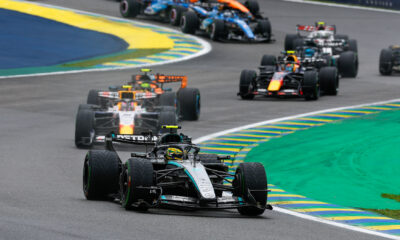
Hamilton set the pace in the opening stages of qualifying.
Ferrari appeared to have a genuine opportunity to challenge for pole position. Leclerc also believed the car had the potential to deliver an even stronger result, but the final qualifying session unfolded differently for the Scuderia.
Hamilton decided to make a small adjustment to the front wing, increasing the angle of the right-hand flap in an attempt to generate more downforce. The change, however, produced an unexpected effect on the car’s balance.
The Front Wing Adjustment Changed Everything
Although Hamilton improved his lap time in Q3, the gain was minimal compared with the progress made by Leclerc and Verstappen. Track evolution also played a role, as grip levels increased throughout the session.
Hamilton admitted that Ferrari had pushed the setup beyond its ideal operating window.
“The car felt good. My team, the engineers and the mechanics did a fantastic job between the sessions,” Hamilton explained.

Ferrari’s front-wing adjustment was intended to unlock additional performance.
He explained that the car had felt exceptionally strong in Q1 and Q2, encouraging him to search for even more performance in the final session.
“The only way to try to extract that potential was to add a little more load to the wing. And by doing that, I think we simply went over the limit,” Hamilton said.
The adjustment left the Ferrari feeling nervous and difficult to control. Hamilton struggled to put together a clean lap in Q3, despite having shown enough pace earlier in qualifying to suggest he could fight for pole position.
Oversteer Exposed Ferrari’s Narrow Setup Window
The change in balance was particularly visible in the car’s behavior through the corners. Hamilton had to make significant oversteer corrections at Turn 3 during both of his Q3 attempts. He also made repeated steering corrections through the final chicane.

Hamilton struggled to keep the Ferrari balanced during his final qualifying attempts.
The Briton described the challenge of finding the right setup balance as a delicate process in which even a small adjustment can have a substantial effect.
“With our car, there is a very fine line between going over the limit and staying below it, and finding that sweet spot is very, very difficult,” he said.
Hamilton added that he had probably found that balance during the first two sessions. However, drivers and engineers must also account for the changing track conditions, which can make an earlier setup decision less effective later in qualifying.
Track Evolution Complicated Ferrari’s Decisions
Singapore is a street circuit that sees limited competitive running outside the race weekend. As more rubber is deposited on the asphalt, grip generally increases, changing how the cars behave from one session to the next.
This creates a difficult challenge for teams. A car may become faster because the circuit offers more grip, rather than because a setup change has improved its performance. Separating those two factors is crucial when deciding whether to make further adjustments.
Ferrari’s decision to add front-wing load was an attempt to capitalize on the potential Hamilton had demonstrated earlier in qualifying. Instead, the change appears to have pushed the car beyond its ideal balance, leaving him unable to reproduce his earlier pace.
Hamilton was ultimately grateful to finish third, particularly given the difficulties he encountered in Q3. Ferrari still showed enough speed to challenge for pole, but the narrow margins in Singapore meant that a small setup misjudgment had a significant impact on the final result.










-
 NOW TRENDING2 months ago
Aston Martin DBX Becomes Harry Da Souza’s Ride in MobLand
-
 TEST DRIVES2 months ago
2026 Maserati GranTurismo Trofeo Review: Miami
-

 INTELLIGENT MOBILITY2 months ago
Tesla Cybercab Navigation Problem Hits Austin Robotaxis
-

 INTELLIGENT MOBILITY2 months ago
2027 Nissan Rogue Hybrid: e-POWER Comes to America
-

 TEST DRIVES2 months ago
2026 Maserati GranTurismo Coupe
-
 Formula12 months ago
Cadillac F1 2026 Faces an Eight-Race Logistics Challenge
-

 NOW TRENDING2 months ago
Land Rover Defender Recall 2026: 23,677 JLR SUVs Affected
-
 NOW TRENDING2 months ago
Every 2026 Chevrolet With AWD or 4WD