
RACING
Lando Norris Warns McLaren After Baku Pace Struggle

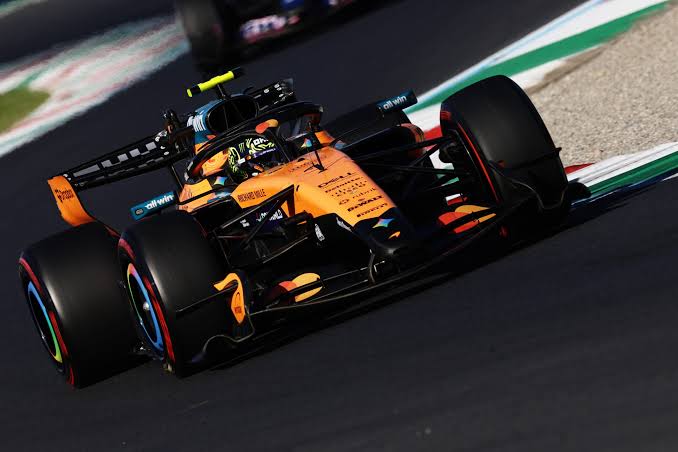
Lando Norris says McLaren is “miles off” the pace in Baku, with Mercedes faster through the slow corners and on the long straight after Thursday practice.
Norris sees a major pace gap in Baku
Lando Norris did not hide his concern after the opening day of the 2026 Azerbaijan Grand Prix.
The McLaren driver said the car feels reasonably good to drive. The problem is the stopwatch. McLaren ended Thursday around 1.5 seconds off George Russell’s Mercedes, which topped both practice sessions.
Norris finished sixth in FP2 with a 1:44.831, 1.484 seconds behind Russell. Oscar Piastri was eighth, 1.510 seconds off the pace.
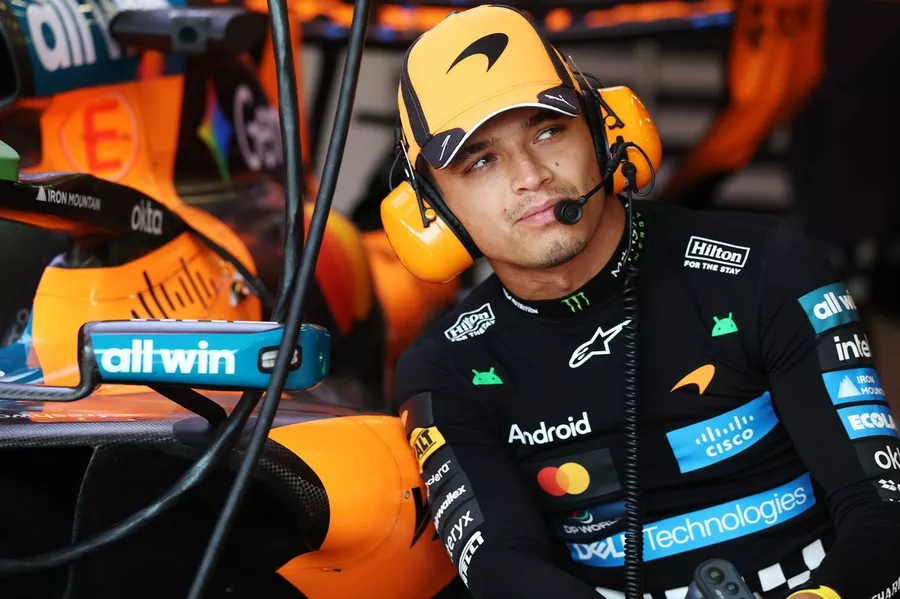
The McLaren MCL40 tackles the Baku City Circuit during Thursday practice.
Norris said the result was difficult to accept because the car itself did not feel particularly bad.
He explained that McLaren expected to struggle at a circuit with very slow corners and an extremely long straight. Mercedes has been stronger in both areas so far.
“We’re miles off,” Norris said after FP2. He added that the car was in the position the team expected, but the size of the gap was still a surprise.
That difference could prove important again on Friday.
Qualifying will take place on September 25, with the race scheduled for Saturday, September 26.
Mercedes is exploiting Baku’s extremes
The Baku City Circuit creates an unusual setup challenge.
The track combines some of the slowest corners on the Formula 1 calendar with its longest straight. Teams therefore have to balance aerodynamic load against drag.
McLaren’s technical team knew that would make the weekend difficult.
Norris said Mercedes is faster in the slow corners. The Silver Arrows are also faster on the main straight.
That means McLaren is losing time at both ends of the lap.
There is little room for easy gains. Adding downforce can help in the corners, but more aerodynamic drag can cost speed on the straight.
That compromise is one of the central engineering problems in Baku.
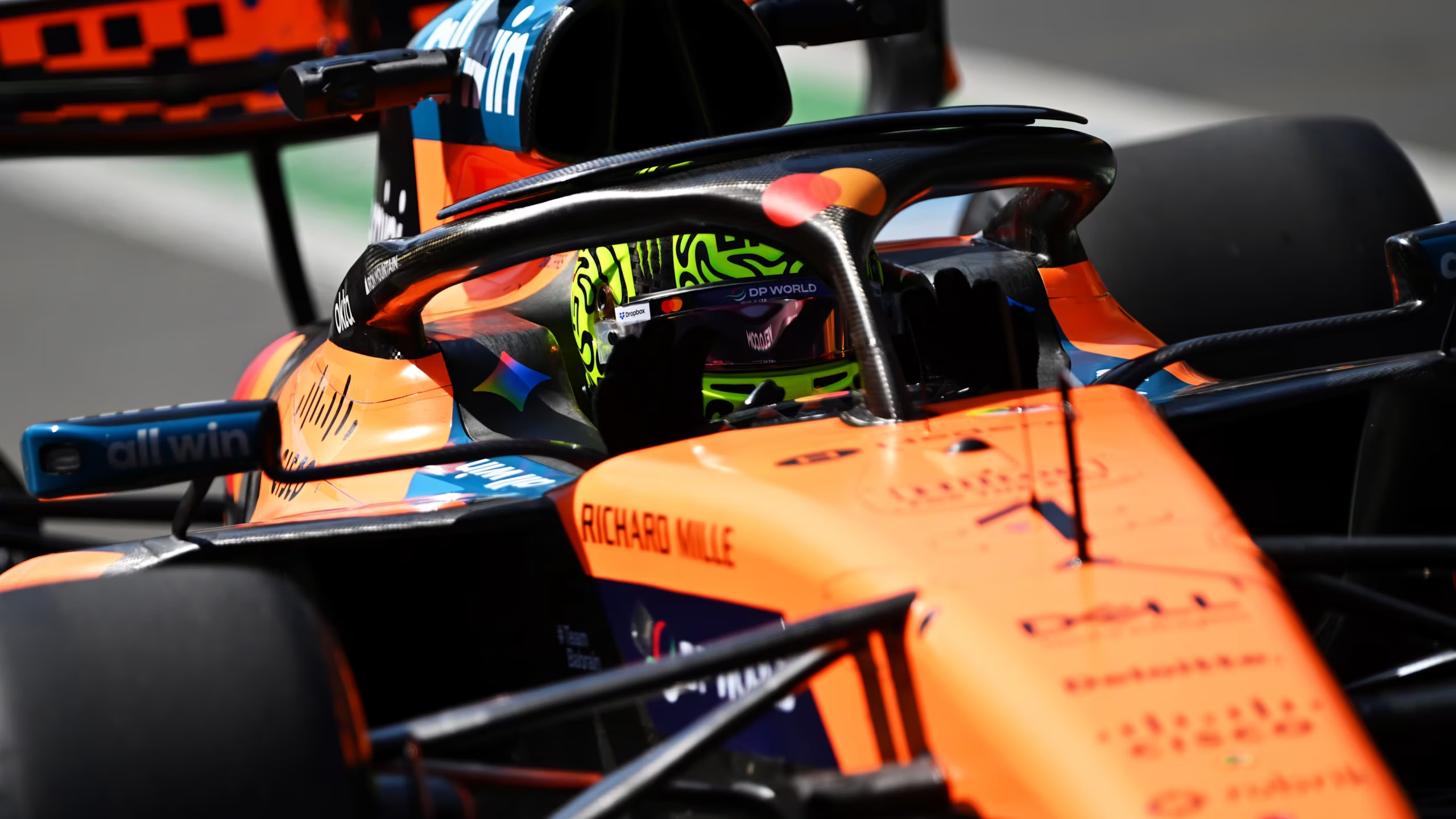
Norris’s MCL40 negotiates the tight sections of the Baku circuit during the team’s Thursday running.
McLaren arrived with a significant upgrade package.
The team brought changes to the sidepods, engine cover, floor, diffuser and rear suspension. A new, higher-downforce H-Wing was also available for evaluation.
The initial data was encouraging.
Technical director and chief designer Rob Marshall said the car was behaving broadly as the team’s simulations predicted. However, McLaren had not yet extracted the full potential of the package.
That distinction is important.
The upgrade does not appear to have failed. Instead, McLaren is still trying to find the right setup for Baku.
Floor damage cost McLaren valuable track time
The first practice session created another problem.
Both McLaren cars suffered floor-related issues. Norris’s MCL40 developed damage to the front of the floor, while a similar problem was later identified on Piastri’s car.
The team applied a temporary fix to keep both cars running.
A more complete solution was then fitted between FP1 and FP2. McLaren said the temporary fix allowed both drivers to complete their second-session programs.
That lost track time matters at a street circuit.
Baku rewards confidence. Drivers need laps to understand the braking points, kerbs and narrow sections.
Norris admitted that the disrupted first session left him a few laps behind the ideal program.
He still said the car felt predictable.
Norris remains confident in the car
The biggest positive for McLaren was the driver’s feedback.
Norris said he felt “pretty good” in the car and believed it was responding well.
The problem was not a lack of confidence in the MCL40. It was the lack of raw pace.
That is an important distinction for the team.
If the handling remains stable, engineers can focus on setup changes and data analysis rather than solving a fundamental balance problem.
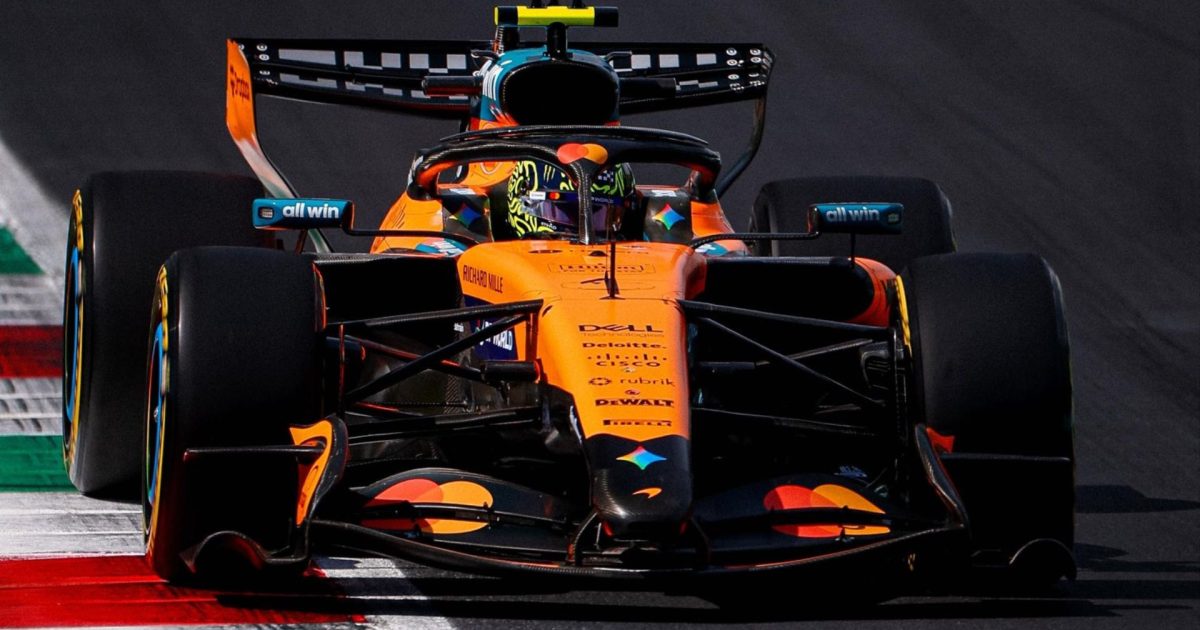
Lando Norris and Oscar Piastri prepare for a challenging Baku weekend with McLaren.
McLaren now has several hours of data to analyse before final practice and qualifying.
The team says the new components are working in the way its simulations predicted. The next task is to dial in the performance and find more time from the package.
The short Baku schedule adds another layer.
There is only one practice session on Friday before qualifying. The race then takes place on Saturday.
That leaves McLaren little time to close the gap.
McLaren needs a stronger Friday
Norris knows the situation can change quickly.
The MCL40 upgrade has already produced useful information, and the team has a full night of data analysis ahead. But Mercedes currently has a clear performance advantage around the Baku lap.
McLaren’s objective is therefore straightforward: improve the setup, unlock more performance and reduce the gap before qualifying.
For Lando Norris in Baku, the car may feel good enough.
Right now, however, it is not fast enough. Friday’s work will determine whether McLaren can turn its new upgrade package into a much closer fight at the front.


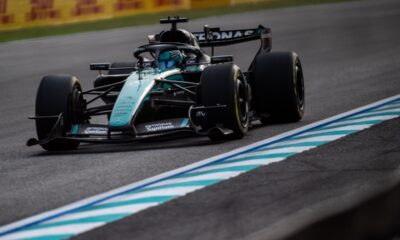







George Russell will start from the back of the grid in Singapore after Mercedes confirmed a power-unit penalty following his engine failure in Sepang.
George Russell’s fight in the 2026 Formula 1 championship has become even more difficult. After retiring from the Malaysian Grand Prix with an engine problem, the Mercedes driver will now face a grid penalty at the Singapore Grand Prix.
Russell had been in contention for a podium in Sepang before the failure ended his race. The retirement also cost him valuable points in his battle with Mercedes teammate Andrea Kimi Antonelli.
Now, Russell arrives at Marina Bay 84 points behind Antonelli. Starting from the back of the grid will make his championship challenge even more demanding.

George Russell faces a difficult Singapore weekend after Mercedes confirmed a power-unit penalty.
Russell Will Start From the Back of the Grid
Mercedes has confirmed that Russell will need additional power-unit components in Singapore after the failure in Sepang.
The British driver has already used four power units during the 2026 season. As a result, another component change will trigger a 10-place grid penalty.
Mercedes team principal Toto Wolff confirmed that Russell will therefore start from the back of the grid on Sunday.
The timing is particularly difficult.
Russell lost a potential podium in Malaysia when his engine problem occurred late in the race. Instead of scoring a major result, he left Sepang without the points he had been fighting for.
Now, Mercedes must give him the strongest possible car for a recovery drive.
The situation also creates an interesting comparison with Antonelli.
The Italian driver received a similar penalty at Monza last month. Despite starting 19th, Antonelli won the race and overcame the disadvantage.
Russell will now face a similar challenge in Singapore.

Mercedes will need to support Russell closely as the driver starts the race from the back.
Mercedes May Have to Change Its Engine Plan
The penalty could also affect Mercedes’ original power-unit strategy.
The team had planned to wait until the United States Grand Prix in Austin before introducing an upgraded engine component.
That plan would have allowed Mercedes to use the updated power unit after Singapore and accept the associated grid penalty at a circuit where overtaking opportunities are generally more favorable.
The engine failure in Malaysia has changed that situation.
Mercedes now has to decide whether to introduce the updated component in Singapore or continue with its available power-unit allocation.
The decision could have implications for the remaining races of the season.
It also highlights one of Mercedes’ biggest challenges in 2026: managing power-unit reliability while competing for the championship.
Power-Unit Reliability Has Become a Mercedes Concern
Mercedes has enjoyed a highly competitive season, but reliability problems have repeatedly interrupted its progress.
Antonelli experienced a power-unit issue in Barcelona.
Russell then suffered problems while leading in Canada and again while fighting for a podium in Sepang.
Those failures have created additional pressure on the team’s power-unit allocation.
For Russell, the consequences are now especially significant.
A driver already trying to close an 84-point championship gap will start from the back at a circuit where track position can be difficult to recover.
That makes every qualifying and Sprint result particularly important for Mercedes this weekend.

Singapore’s narrow street circuit will make Russell’s recovery drive particularly challenging.
Mercedes Still Has Questions About Its Latest Upgrade
Russell’s power-unit penalty is not Mercedes’ only concern in Singapore.
The team is also still trying to understand whether its latest aerodynamic package actually delivered the expected performance gain.
The upgrade debuted in Malaysia, but the weekend produced mixed results.
Mercedes found additional aerodynamic load in some corners, yet the car did not show the expected straight-line advantage.
The team also struggled with balance and tire management.
That has prompted Mercedes to compare the latest package with the previous specification during the Singapore weekend.
The two cars could potentially run different configurations to give the engineers a clearer comparison.
Singapore should provide useful information because its characteristics are very different from those of Sepang.
The Marina Bay circuit features mostly low- and medium-speed corners, along with bumps, curbs and high temperatures.
That could help Mercedes determine whether the Malaysian problems were caused by the new package, the setup or the track conditions.
Russell Faces a Major Recovery Mission
The Singapore Grand Prix now presents Mercedes with two objectives.
The team needs to understand its latest upgrade while giving Russell the tools to recover from the back of the grid.
For Russell, the championship situation is becoming increasingly difficult. The Sepang retirement already created a significant points deficit, and the Singapore penalty adds another obstacle.
But the Antonelli example from Monza shows that a back-of-grid start does not automatically eliminate the possibility of a strong result.
Mercedes will therefore need to maximize every opportunity.
Russell’s Singapore weekend may be one of the most important recovery challenges of his 2026 season.

McLaren believes Singapore offers a major opportunity to reverse its recent form and extract the full potential of the MCL40.
McLaren is looking to reset its Formula 1 season in Singapore. After difficult weekends in Baku and Sepang, the team believes the Marina Bay circuit could provide an opportunity to return to the front.
Lando Norris’ victories in Hungary and the Netherlands now feel increasingly distant. Since then, McLaren has struggled to maintain the development momentum that previously made the MCL40 one of the strongest cars on the grid.
The team is determined to change that in Singapore.
McLaren technical director Neil Houldey believes the team has the pace needed to fight for victory, but it must execute the weekend much more effectively.

McLaren heads to Singapore looking to reverse its recent decline in performance.
McLaren Believes Singapore Can Change Its Momentum
The recent results have raised questions about McLaren’s development direction.
The latest upgrade package was expected to keep the MCL40 moving forward. Instead, the car appeared less competitive in both Baku and Sepang.
McLaren now wants to understand exactly why it failed to extract the expected performance.
Singapore presents a different challenge.
The Marina Bay circuit is dominated by slower corners, heavy braking zones and uneven sections of track. The race also takes place at night, while the Sprint format leaves teams with less practice time.
That combination means preparation will be particularly important.
Houldey says McLaren needs to optimize its cooling system because of the high temperatures expected throughout the weekend.
The setup will also require a careful compromise between aerodynamic performance and mechanical behavior over the bumps and curbs.

Singapore’s bumps, curbs and high temperatures create a very different challenge for the MCL40.
McLaren Must Unlock the MCL40’s Full Potential
Houldey believes McLaren did not maximize the car’s potential during the previous two races.
That assessment is important because the team has not necessarily lost all of its underlying pace.
Instead, McLaren believes it has failed to put the MCL40 into the right operating window.
The team has also faced difficulties extracting maximum performance from the Mercedes power unit in Norris’ car.
A lack of suitable top speed has cost performance on some laps, adding another layer to McLaren’s recent struggles.
Singapore should reduce some of those concerns because outright top speed is less important than at circuits such as Baku.
The priority will instead be finding the correct aerodynamic balance while ensuring the car remains predictable over the street circuit’s bumps and curbs.
McLaren also knows that performance can change significantly from one circuit to another.
That gives the team reason to remain confident heading into the third race of the current triple-header.
McLaren Wants to Win Both Singapore Races
The Sprint format makes preparation even more important.
Teams have less time to evaluate setup changes before competitive sessions begin. McLaren therefore plans to arrive with a clear baseline while remaining ready to react to changing track conditions.
Safety-car periods and incidents could also have a major impact on the weekend.
Houldey has set an ambitious target.
McLaren wants to win both races in Singapore.
That means maximizing every available opportunity, from qualifying performance to tire management and race strategy.
The team believes the MCL40 remains fast enough to compete at the front. The challenge is turning that potential into consistent results.

Lando Norris will be central to McLaren’s attempt to return to the front in Singapore.
McLaren Is Still Fighting for the Championship
The Singapore weekend arrives with seven races remaining in the 2026 season.
That leaves McLaren with significant opportunities in both championships.
The team is currently trying to close the gap to Ferrari, which sits second among the constructors and has extended its advantage to 89 points.
McLaren therefore needs more than a strong weekend. It needs to turn its pace into consistent podium finishes and victories.
The recent difficulties have provided useful data. The team can now use that information to identify areas that require improvement.
The objective is clear: leave Baku and Sepang behind, extract more from the MCL40 and rebuild momentum.
McLaren believes the opportunity is still there. Singapore could be the weekend when the team finally turns that belief into results.

James Vowles admits Williams feared Carlos Sainz or Alex Albon could leave during the team’s difficult 2026 season, but both drivers ultimately backed the project.
Williams entered the 2026 Formula 1 season expecting to build on its progress from the previous year. Instead, the team faced a major setback.
The FW48 arrived overweight, lacked the expected performance and left Williams fighting near the back of the field for much of the season.
The difficult situation created another concern for team principal James Vowles. He feared Carlos Sainz or Alex Albon could decide to leave the team.
That possibility added another layer of pressure to an already challenging season. Williams needed to improve the car while also maintaining a strong working relationship with its two drivers.

Carlos Sainz and Alex Albon remained committed to Williams despite its difficult start to 2026.
Williams Faced the Risk of Losing a Driver
The scale of Williams’ problems made the situation particularly difficult.
The team missed its Barcelona preseason shakedown and eventually put an FW48 on track that was around 28 kilograms above the minimum weight limit.
After finishing fifth in the 2025 Constructors’ Championship, Williams dropped to ninth in 2026.
That was a significant change in competitive performance.
Vowles later acknowledged that he had considered the possibility of losing one of his drivers during the most difficult periods of the season.
He also confirmed that potential routes existed for a driver to leave, although the contractual circumstances were different for each case.
For Williams, the priority was therefore twofold. The team had to address the technical problems while continuing to build trust with Sainz and Albon.

James Vowles had to manage the team’s technical challenges while maintaining confidence within the driver lineup.
Sainz and Albon Chose to Support the Project
Vowles had already spoken with both drivers before the season began.
He contacted Albon first and then Sainz. The message was direct: Williams was facing serious problems.
The FW48 would be heavy, and the team did not yet know the full impact that would have on its performance.
Albon responded immediately.
According to Vowles, the driver made it clear that he wanted to remain involved and asked what he could do to help the team.
Sainz took a more analytical approach.
He asked questions about the car, the team’s understanding of the problem and the development plan.
His response eventually led to the same conclusion: he wanted to help.
Both drivers then visited Williams’ factory in Grove.
Their presence sent an important message to the wider organization. They were not looking for someone to blame. They were showing that they remained engaged with the team’s recovery effort.
That support became especially valuable as Williams continued working through a difficult season.
Baku Finally Gave Williams a Reason for Optimism
Williams continued developing the FW48 through the summer.
The team faced further difficult weekends, but Sainz and Albon continued to support the development program.
That commitment mattered to Vowles.
The situation eventually began to change in Baku, where Williams introduced a significantly lighter chassis.
The weight reduction addressed one of the major weaknesses that had affected the FW48 throughout the season.
Sainz also reached Q3 for the first time in 2026, providing a visible sign that the team’s development work was beginning to produce results.

The lighter Williams chassis helped produce one of the clearest signs of progress during the 2026 season.
The Biggest Victory Was Restoring Confidence
The improvement in Baku did not turn the FW48 into a front-running car overnight.
It did, however, provide something Williams badly needed: evidence that its development plan was working.
For much of 2026, the team had been dealing with problems that went far beyond a normal performance deficit.
Engineers had to reduce the car’s weight, improve its pace and understand why the project had fallen so far behind its expectations.
At the same time, the leadership team needed to maintain a productive relationship with two drivers who had committed to Williams’ long-term plans.
Sainz and Albon ultimately chose to remain part of that process.
For Vowles, that commitment carried significant value.
Williams’ 2026 crisis was therefore about more than lap time. It was also about maintaining trust while rebuilding the team’s competitive foundation.
The progress in Baku showed that the work was beginning to move in the right direction.
And for Williams, restoring that confidence could prove just as important as any single result.
-

 NOW TRENDING1 month ago
Tesla Cybercab Gets September 3 Austin Launch Date
-

 NOW TRENDING2 months ago
Audi’s New SUVs Could Help Reverse Its Sales Decline in 2026
-

 TEST DRIVES1 month ago
2025 Ford Bronco Sport Badlands: The Adventure SUV You Can Drive Every Day
-

 TEST DRIVES1 month ago
2026 Toyota GR Supra MkV Final Edition
-
 INTELLIGENT MOBILITY2 months ago
GM Super Cruise: How It Works and What Comes Next in 2028
-

 NOW TRENDING2 months ago
Toyota Camry Recall Expands to More Than 500,000 Vehicles in the U.S.
-
 NOW TRENDING2 months ago
2027 Toyota Corolla Celebrates 60 Years With Special Edition
-

 NOW TRENDING2 months ago
Rivian R2 Autonomy+ Adds New Hands-Free Driving Features
You must be logged in to post a comment Login