
RACING
Audi Plans to Appeal FIA Decision on Tsunoda Penalty


Audi has notified the FIA of its intention to appeal the decision not to penalize Yuki Tsunoda for causing an extra formation lap at the Italian Grand Prix.
Audi is preparing to challenge the FIA’s decision regarding Yuki Tsunoda at the Italian Grand Prix.
The team has officially notified the FIA of its intention to appeal after stewards decided not to penalize the Racing Bulls driver for an extra formation lap.
Why Tsunoda Avoided a Penalty
The controversy began during the restart on lap six.
Tsunoda was positioned in his correct grid slot but was angled toward the inside wall. Race director Rui Marques was uncomfortable with the position and ordered an additional formation lap.

Yuki Tsunoda avoided a penalty after the FIA determined that he did not directly cause the extra formation lap.
Article B5.9.4 of the 2026 F1 Sporting Regulations states that a driver who causes an extra formation lap and can then take part in it must enter the pit lane and restart from the back.
However, the stewards concluded that Tsunoda did not directly cause the additional lap.
They determined that the race director had acted out of caution and that Tsunoda had remained within his grid position without affecting other drivers.
Audi Says the Rule Was Not Properly Applied
The decision had a direct impact on Audi.
Tsunoda finished 10th, scoring the final championship point, while Audi driver Gabriel Bortoleto finished 11th.
Audi has therefore decided to challenge the ruling.

Gabriel Bortoleto finished 11th after Tsunoda retained 10th place and the final championship point.
The stewards also noted that Racing Bulls had not been informed that Tsunoda was considered responsible for the extra formation lap.
Without that information, the team had no reason to instruct him to enter the pit lane.
Audi Has a Limited Window to Decide
Audi’s notification does not necessarily mean the team will proceed with a full appeal.
Under the FIA International Sporting Code, competitors have one hour to notify their intention to appeal after a stewards’ decision.
That notification gives Audi an additional 96 hours to examine the case before deciding whether to continue.

Audi has 96 hours to evaluate the stewards’ decision before deciding whether to proceed with its appeal.
The stewards argued that the mandatory stop-and-go penalty applies when a driver fails to enter the pit lane after being identified as the cause of an extra formation lap.
Because neither Tsunoda nor Racing Bulls knew they were being considered responsible, the stewards concluded that imposing the penalty would not be appropriate.
Audi has declined to comment further while the matter remains within the FIA appeal process.









The Aston Martin Valkyrie heads to Barcelona seeking to extend its points streak and strengthen its position in the 2026 World Endurance Championship.
The Aston Martin Valkyrie will make its Spanish competition debut at the Circuit de Barcelona-Catalunya as the FIA World Endurance Championship approaches the final two rounds of the 2026 season. The seventh round will take place at the 2.9-mile circuit in Montmeló, where Aston Martin THOR Team aims to build on a consistent run of results.
Barcelona marks the first appearance of the Spanish circuit on the WEC calendar. For Aston Martin, it represents another opportunity to demonstrate the Valkyrie’s progress against established rivals in the Hypercar class, with the season finale at Monza still to come.
Aston Martin Valkyrie Extends Its Points Streak
The Valkyrie arrives in Spain after scoring points in eight consecutive races. That run includes fourth-place finishes at the 6 Hours of Spa-Francorchamps and Lone Star Le Mans at Circuit of the Americas in Austin, Texas.
The team’s latest performance came at Fuji Speedway in Japan, where both Valkyries started inside the top six for the first time. The No. 007 car, driven by Britain’s Tom Gamble and Harry Tincknell, also led during the race. Meanwhile, the No. 009 entry, shared by Spain’s Alex Riberas and Denmark’s Marco Sørensen, remained in contention for a podium before the final Safety Car period changed the race’s closing phase.

The Aston Martin Valkyrie showed front-running pace at Fuji, giving the team momentum heading into Barcelona.
The result reinforced the progress made by Aston Martin THOR Team throughout the campaign. However, the team must convert that speed into stronger finishing positions if it hopes to climb the manufacturers’ standings before the season ends.
Championship Standings Leave Room for Progress
Aston Martin sits sixth in the FIA Hypercar World Endurance Manufacturers’ Championship with 54 points. The team is 42 points behind fourth place, with a maximum of 88 points still available across the Barcelona round and the season-ending 6 Hours of Monza on November 8.
That gap makes the remaining races particularly important. A strong result in Spain could improve Aston Martin’s position, although the final standings will depend on the performance of its competitors as well as its own results.
Consistency has been one of the Valkyrie’s defining characteristics this season. Its consecutive points finishes show that the car can regularly challenge for meaningful results, even as the team continues to pursue the pace required to compete more consistently at the front.
The Valkyrie Combines a V12 With Racing Technology
The competition version of the Aston Martin Valkyrie is developed from the road-going hypercar by Aston Martin and The Heart of Racing. Its design combines a race-optimised carbon-fibre chassis with a modified 6.5-litre V12 engine.
In standard form, the powerplant produces more than 1,000 bhp and can rev to 11,000 rpm. For endurance racing, however, the car must comply with the regulations governing the WEC Hypercar class and IMSA’s GTP category. Its maximum permitted output is therefore limited to 500 kW, equivalent to approximately 671 bhp.
The Valkyrie’s carbon-fibre construction, aerodynamic package and naturally aspirated V12 form the foundation of its racing specification.
The regulatory power limit means the competition car cannot simply rely on the output of its road-going counterpart. Instead, performance depends on the overall package, including aerodynamic efficiency, chassis behaviour, tyre management and how effectively the team executes its race strategy.
Barcelona will provide a useful test of that balance. The circuit combines a fast opening sector with a slower final section, creating different demands on the car across a single lap.
Barcelona Brings a New WEC Challenge
Although Barcelona is familiar to many drivers and teams, its inclusion in the WEC schedule presents a new challenge for the Hypercar field. The circuit’s layout and traffic conditions could influence how the race develops, particularly when faster prototypes negotiate slower cars during long-distance competition.
Tincknell believes the circuit’s characteristics could suit the Valkyrie, particularly following the return of the final two corners to their original high-speed configuration. The British driver also sees the race as an opportunity to respond after Fuji, where the team showed encouraging pace but did not fully convert it into the result it wanted.
Gamble is equally optimistic. He returns to Barcelona after previously finishing on the podium there and hopes to carry the speed demonstrated in Japan into the Spanish round.

Barcelona’s mix of high-speed and low-speed sections will test the Valkyrie’s balance and the team’s ability to manage traffic.
For Riberas, the event has additional significance. The Spanish driver will contest his first home WEC race at the circuit where he grew up. He described the opportunity to compete there in a Valkyrie with Aston Martin THOR Team as a dream come true, while expressing confidence in the car’s potential after Fuji.
Sørensen, meanwhile, highlighted traffic management as a possible deciding factor. Barcelona’s relatively narrow layout could make overtaking and navigating slower traffic particularly challenging for the Hypercar field.
Aston Martin Focuses on Execution for the Final Rounds
Team principal Ian James believes recent races have demonstrated that the Valkyrie can fight near the front when conditions suit the car. He also pointed to the team’s run of points finishes as evidence that it has been able to make the most of its available performance.
The priority for Barcelona will be to execute the race cleanly, avoid mistakes and take advantage of opportunities as they arise. With only two rounds remaining, every point could influence Aston Martin’s final championship position.
Adam Carter, Aston Martin’s head of endurance motorsport, also sees reasons for confidence. He noted that the Valkyrie has performed as expected on circuits with characteristics similar to Barcelona, while acknowledging the experience and strength of the opposition.
The Spanish race will therefore offer a fresh measure of the Valkyrie’s development. Aston Martin has established a reliable points-scoring record, but a stronger finish would provide a more significant reward for the progress made throughout 2026.
With the Monza finale approaching, the objective is clear: maintain the points streak, challenge for a better result and finish the season as strongly as possible.
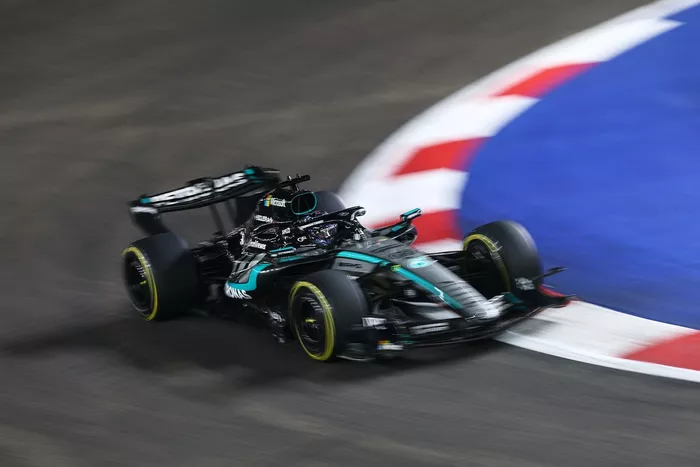
Mercedes will run its latest W17 upgrades on both cars as it evaluates their potential for 2027.
Mercedes intends to equip Andrea Kimi Antonelli and George Russell with its latest W17 upgrade package at the United States Grand Prix in Austin. After evaluating the new components in Singapore, the team wants to understand how to unlock their performance more consistently and determine whether the technical concept could influence the development of the 2027 W18.
Mercedes Will Run the Latest Upgrades on Both Cars
Mercedes introduced its latest upgrade package at Sepang and initially evaluated it on Antonelli’s car during the Singapore Grand Prix weekend. The team compared the updated W17 with its previous specification to understand how the changes affected the car’s balance and performance.
Bradley Lord, Mercedes’ deputy team principal, confirmed the team’s intention to continue the evaluation in Austin, with both cars using the updated configuration. Preparing two different specifications in Singapore required considerable work from the mechanics, but the comparison provided useful information for the engineers.
The analysis showed that Mercedes extracted more potential from the updated package during qualifying than it consistently maintained in the race. The next step is to identify the setup conditions that allow the new components to deliver their best performance.

Mercedes will evaluate its latest W17 upgrades on both cars at the Circuit of The Americas.
Why Mercedes Needs to Improve the W17’s Balance
The main challenge is the narrow operating window of the new package. Mercedes believes the upgrades can make the W17 faster, but the car must be set up correctly to deliver those gains.
When the balance moves outside that window, the performance advantage can disappear quickly. As a result, the drivers may struggle to reproduce the same pace across qualifying and race conditions.
Antonelli showed competitive speed in Singapore, although Mercedes acknowledged that Red Bull remained particularly strong. The results offered encouraging signs, but they also demonstrated that the team still needs to understand how the updated components behave in different conditions.
Running the same specification on both cars in Austin should provide a more complete comparison. Engineers can examine the data from both drivers and determine whether the findings from Singapore remain valid at another circuit.
Mercedes Sees Potential for the 2027 W18
The upgrade package could have implications beyond the current season. Mercedes is evaluating whether the concept introduced at Sepang could provide a starting point for the W18, its 2027 Formula 1 car.
Antonelli has emphasized the importance of identifying the conditions in which the package performs best. Toto Wolff has also indicated that the concept could represent the right direction for next year, although further analysis is required before the team makes a final decision.

Russell is expected to evaluate the same upgrade specification as Antonelli in Austin.
This longer-term objective helps explain why Mercedes is continuing to investigate the package despite its initial difficulties. The data could help engineers identify which technical solutions deserve further development, even if the current configuration does not deliver consistent gains immediately.
However, the updates should not be considered a confirmed blueprint for the W18. Mercedes must first assess their effectiveness and determine whether the concept offers the best direction for its next-generation car.
Austin Will Be an Important Test for Mercedes
The United States Grand Prix will provide another opportunity to evaluate the updated W17 under different circuit conditions. The Circuit of The Americas features significant elevation changes, slower corners and faster sections that will challenge the car’s balance.
Using the same specification on both cars should help Mercedes compare the results more effectively. The engineers will be looking for evidence of consistent performance and a clearer understanding of how the upgrades respond to different setup choices.

Austin will test whether Mercedes can extract consistent performance from its latest W17 upgrades.
Mercedes has two objectives: remain competitive in the current season and collect data that can guide future development. Its ability to find a reliable setup window will determine how much performance the team can extract from the new components.
The decision to use the package on both cars demonstrates that Mercedes considers it worth further investigation. Whether the concept influences the 2027 W18 will depend on the results gathered in Austin and during the remaining races.

Formula 1 is targeting a return to Africa with a new circuit planned near Rwanda’s capital, Kigali.
Formula 1 could return to Africa in the early 2030s, with Rwanda advancing plans for a brand-new racing circuit near Kigali. The proposed venue would mark a major step toward bringing the championship back to the continent for the first time since 1993.
Rwanda Emerges as a Candidate for Formula 1’s African Return
The last Formula 1 Grand Prix held in Africa took place at South Africa’s Kyalami Circuit on March 14, 1993. Alain Prost won the race, finishing ahead of Ayrton Senna, while Michael Schumacher competed in the early stages of his Formula 1 career.
More than three decades later, Africa remains absent from the Formula 1 calendar despite the championship’s global expansion. Rwanda has emerged as a potential host, with government backing and a proposed circuit site helping advance the project.
South Africa’s Kyalami had long been viewed as a natural candidate for the championship’s return. Rwanda’s plans, however, would introduce a new venue rather than rely on an existing Formula 1 circuit.

The 1993 South African Grand Prix at Kyalami remains Formula 1’s most recent race on African soil.
A New Circuit Is Planned Near Kigali
The proposed circuit would be built in Bugesera, approximately 25 miles south of Kigali. Current plans describe a layout of 17 corners stretching just under four miles, supported by the facilities needed to host a Formula 1 Grand Prix.
Former Formula 1 driver and test driver Alex Wurz is expected to lead the circuit design through his company, WurzDesign. The proposed layout is intended to take advantage of the area’s undulating terrain, drawing inspiration from the flowing characteristics of established circuits such as Spa-Francorchamps in Belgium and Suzuka in Japan.
The project remains at an early stage, and several details still need to be confirmed. Construction progress, final circuit specifications, infrastructure development and the timing of the first race will all be important factors in determining whether Rwanda can meet the proposed early-2030s target.

The planned Bugesera venue would combine a new racing layout with facilities designed for international motorsport.
Why Formula 1’s Return to Africa Matters
An African Grand Prix would fill a significant geographical gap in Formula 1’s calendar. The championship races across Europe, Asia, the Americas and the Middle East, but Africa has remained without a round since 1993.
A race in Rwanda could also provide an opportunity to increase international tourism and investment. The government has used major sporting events as part of its broader efforts to raise the country’s international profile, and Formula 1 could bring global attention to Kigali and the surrounding region.
However, the economic impact would depend on the project’s costs, the number of visitors attracted, local employment opportunities and the long-term use of the circuit outside race weekends. Hosting a Grand Prix requires substantial investment in transport, accommodation, security and event infrastructure.
The proposed race has also raised human rights concerns. Rwanda’s government has faced criticism from organizations including Amnesty International over its human rights record. The prospect of hosting a high-profile sporting event therefore brings questions about governance and accountability alongside the potential tourism and economic benefits.

Kigali could benefit from increased international visibility if Rwanda secures a place on the Formula 1 calendar.
Could South Africa Still Host a Grand Prix?
Rwanda’s plans do not necessarily end South Africa’s ambitions to bring Formula 1 back to the continent. Kyalami remains an important part of the sport’s history, and South African organizers have continued to express interest in hosting a future race.
A second African Grand Prix would depend on Formula 1’s calendar capacity, commercial priorities, circuit readiness and the financial terms available to prospective hosts. Although some countries have hosted more than one race in a season, adding another event requires agreement with Formula 1 and the championship’s commercial stakeholders.
For now, Rwanda’s proposed circuit represents a significant development in the effort to restore Formula 1 racing in Africa. The early 2030s remain a target rather than a confirmed debut date, and the project must progress from planning to construction before the championship’s return can be guaranteed.
-

 NOW TRENDING2 months ago
Tesla Cybercab Gets September 3 Austin Launch Date
-
 INTELLIGENT MOBILITY2 months ago
GM Super Cruise: How It Works and What Comes Next in 2028
-
 TEST DRIVES1 month ago
2026 Toyota GR Supra MkV Final Edition
-

 TEST DRIVES2 months ago
2025 Ford Bronco Sport Badlands: The Adventure SUV You Can Drive Every Day
-
 NOW TRENDING2 months ago
2027 Toyota Corolla Celebrates 60 Years With Special Edition
-
 RACING2 months ago
FIA Reveals Second ADUO Results With Red Bull-Ford Still on Top
-
 NOW TRENDING2 months ago
Aston Martin Valen: The Most Powerful Front-Engined Supercar
-

 NOW TRENDING2 months ago
2027 Jeep Wrangler Smoky Mountain Edition Debuts With 4×4
You must be logged in to post a comment Login