
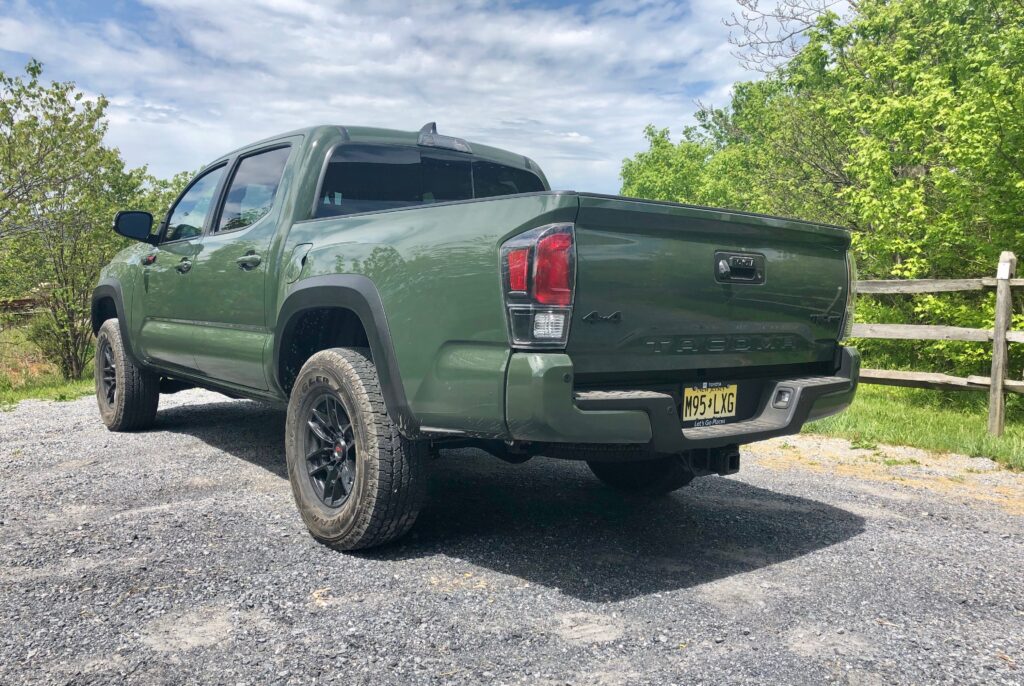
The 2020 Tacoma TRD Pro Double Cabin while on paper competes with other mid-size pickups the fact is that Toyota has an unfair advantage with a history of excellent reliability. Furthermore, it arguably has the largest cult following, that lovingly refers to the Tacoma as Taco.
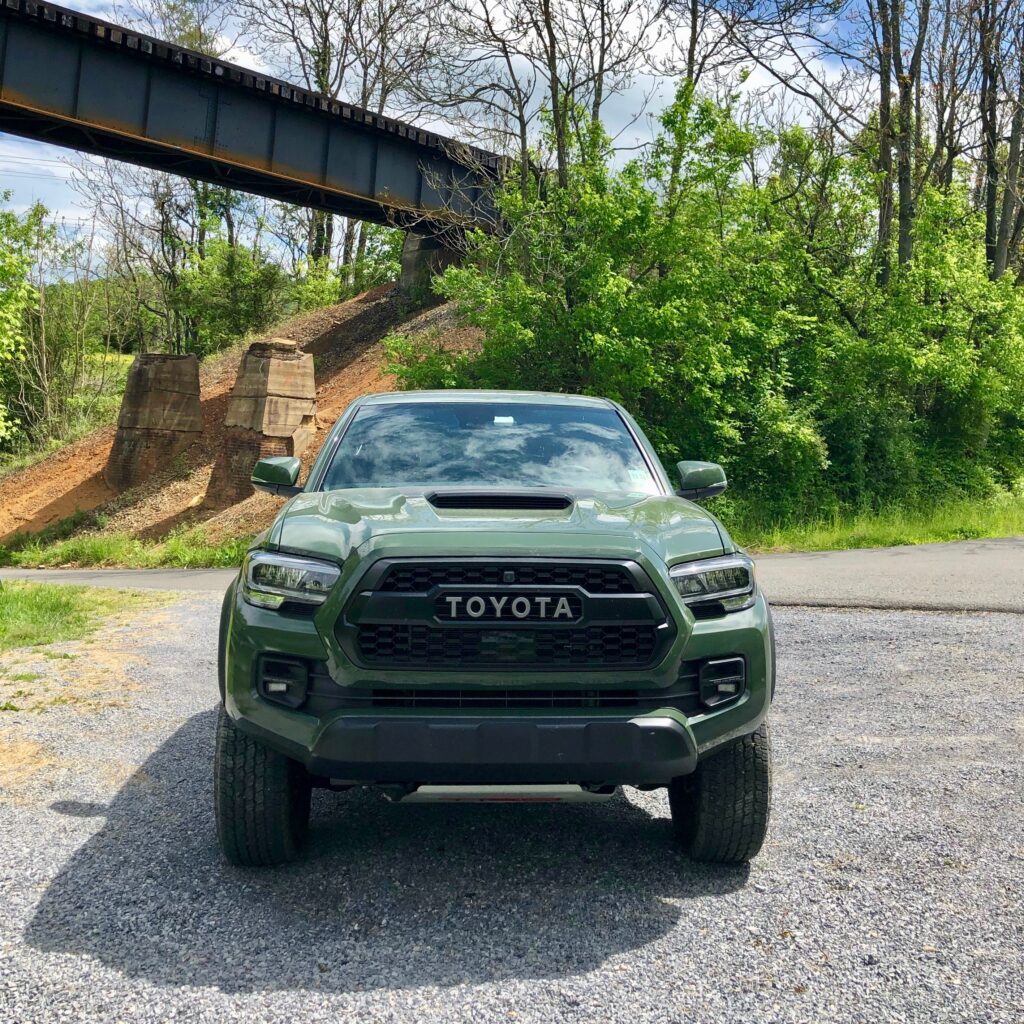
The downsized dimensions, coupled with raw power under the hood, makes it the best alternative to full-blown, larger trucks costing several thousand more. So, the question you’re probably asking is, does the 2020 Toyota Tacoma stay true to its roots while introducing a few much-anticipated features? We’ll attempt to answer those and other questions in this hands-on review.
Under the Hood
The 2020 Tacoma comes loaded with a powerful V-6 engine, that offers decent performance and more than enough muscle to tow most stuff. The V6 is paired with an equally efficient 6-speed automatic, which in our experience is highly reliable and capable of outputting some excellent 4×4 power.
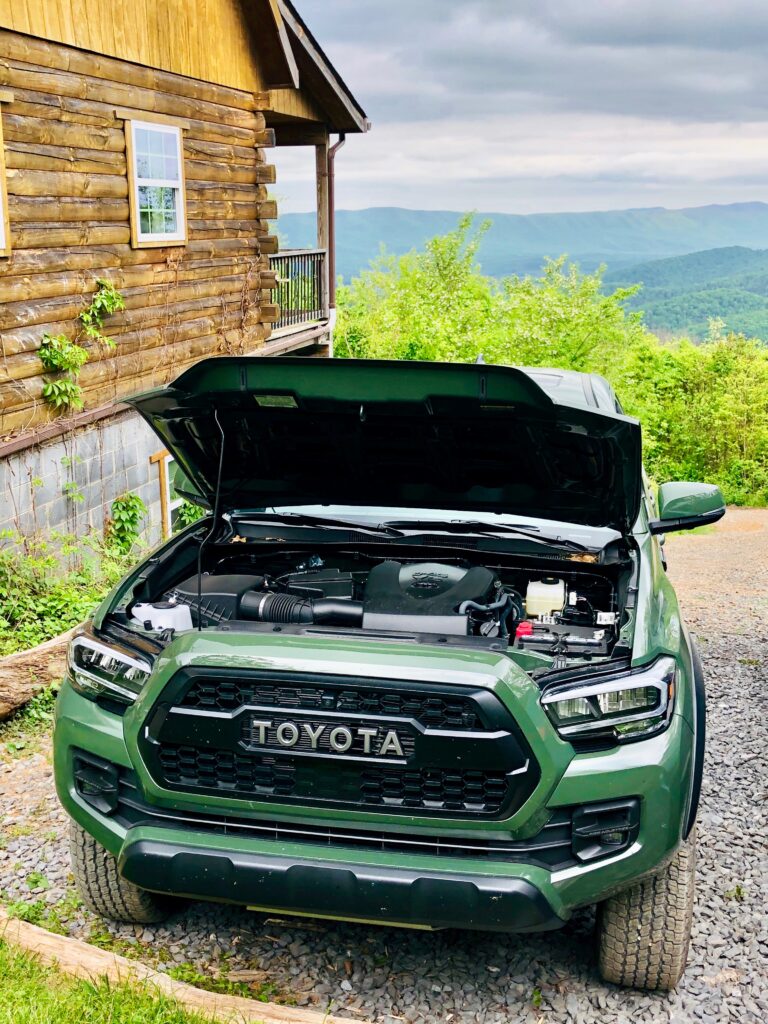
The TRD Pro version (the one we tested) is an off-roading beast. We took it on a trip through some pretty rough terrain, and the Tacoma performed as we expected. The right quality and handling throughout the trip were superb, which means that you can take it out anywhere and rely on it getting you back home.
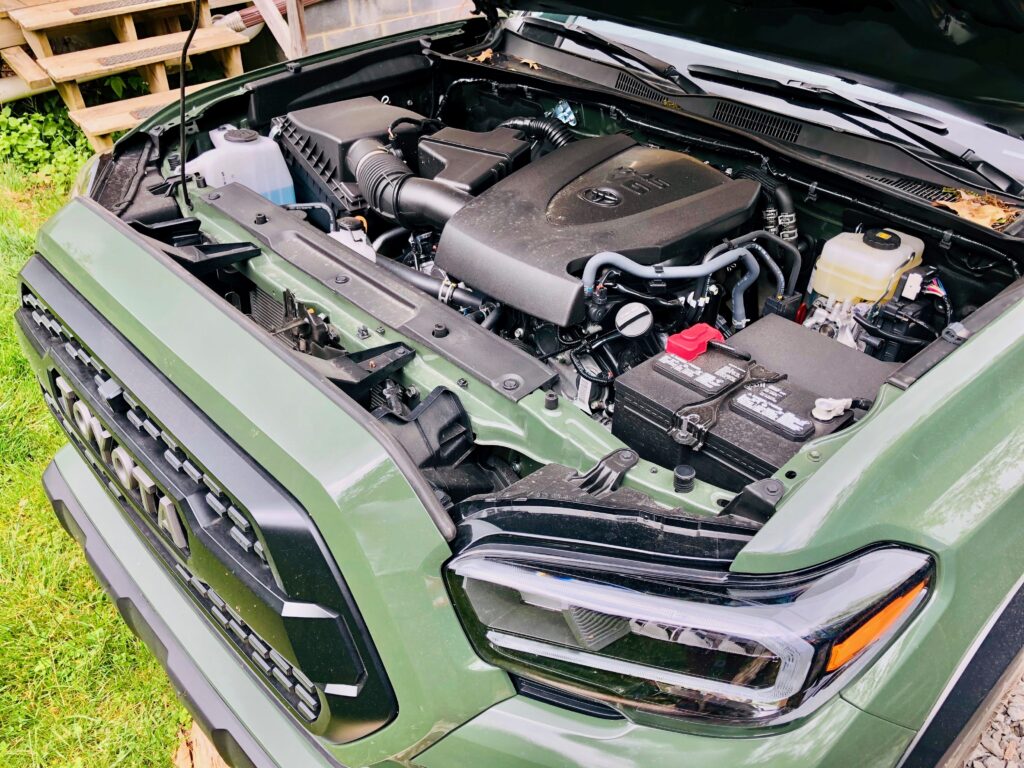
The 2020 model comes with a lifted suspension, an excellent set of shock absorbers and tires that we think will keep most casual off-roaders happy. That said the Tacoma performs equally well on the road as it does off-road. However, when driven on the road, you don’t feel as though the vehicle is being stressed in any way, which is why most people will feel more than confident taking it off-road.
Towing Capacity
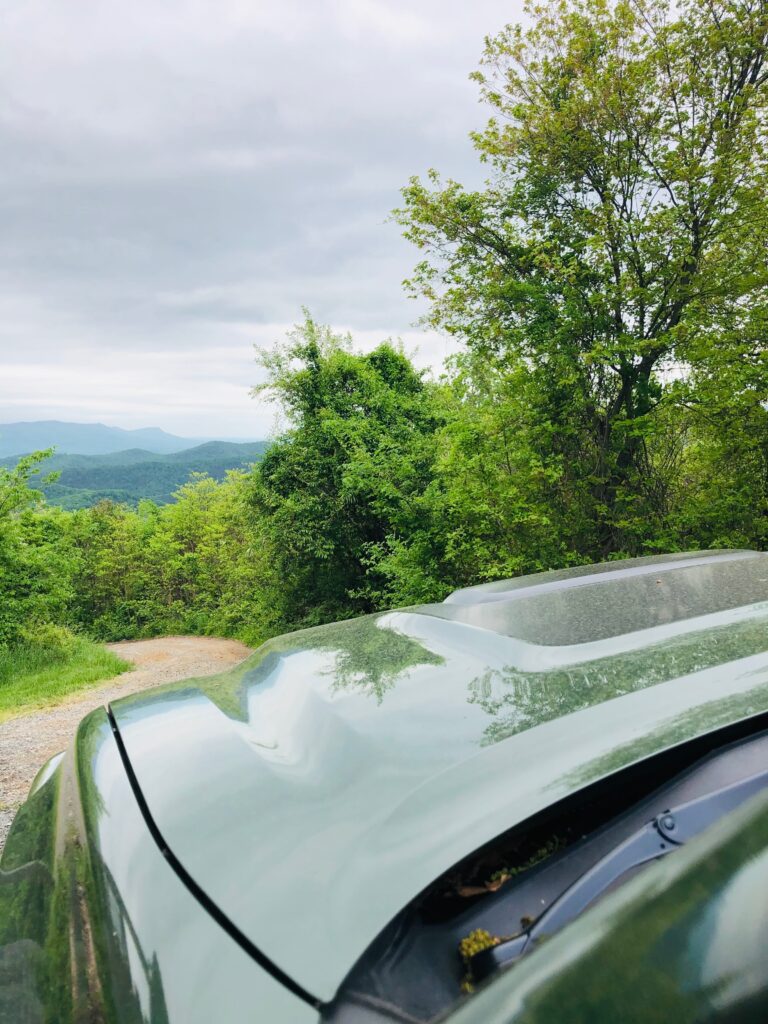
The 2020 Tacoma TRD Pro can easily tow up to 6800 pounds via the rear-wheel drive. When the four-wheel-drive mode of the vehicle is activated that towing capacity goes down to around 6500 pounds which is pretty decent compared to others in this class.
Interior Features and Cargo Space
We love the fact that the 2020 Toyota Tacoma TRD Pro continues to stay true to its roots. The Tacoma continues to boast of that much loved utilitarian cabin layout with familiar materials. While the Pro we had did have a few hard plastics, the overall approach here is minimalistic. However, Toyota did add a power-adjustable driver’s seat, which was something many people were demanding for years.
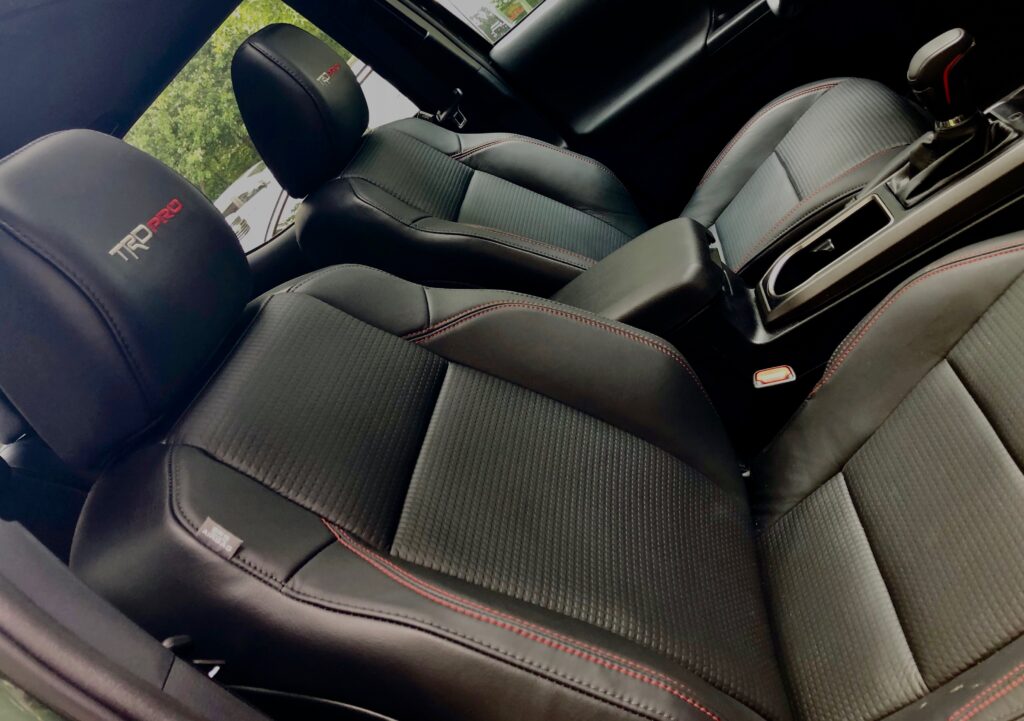
The sear passenger seats aren’t cramped like previous models, which is another welcome addition to the design possibly down to better space maximization. The vehicle has enough volume to comfortably accommodate up to a six-foot bed, with limited storage cubbies and added carry-on space.
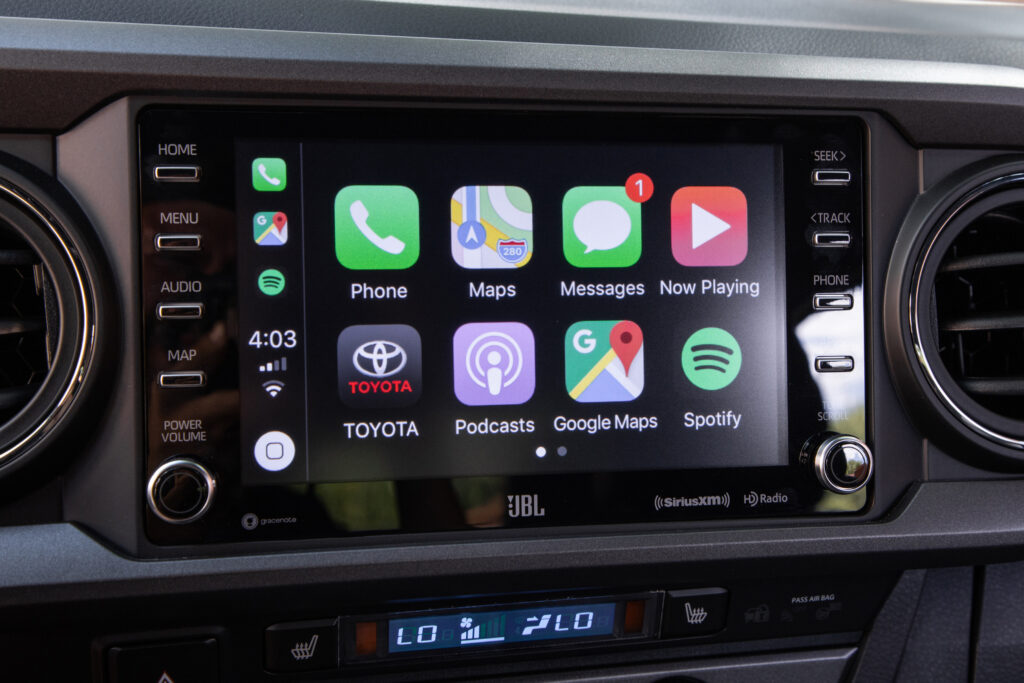
The Tacoma now features a new 8-inch touchscreen which is compatible with Android Auto, Apple CarPlay and even Amazon’s Alexa. There is another four-inch screen hooked up to the instrument cluster which looks pretty good with an array of analogue gauges. There is also support for wireless charging and a physical handbrake.
Final Verdict
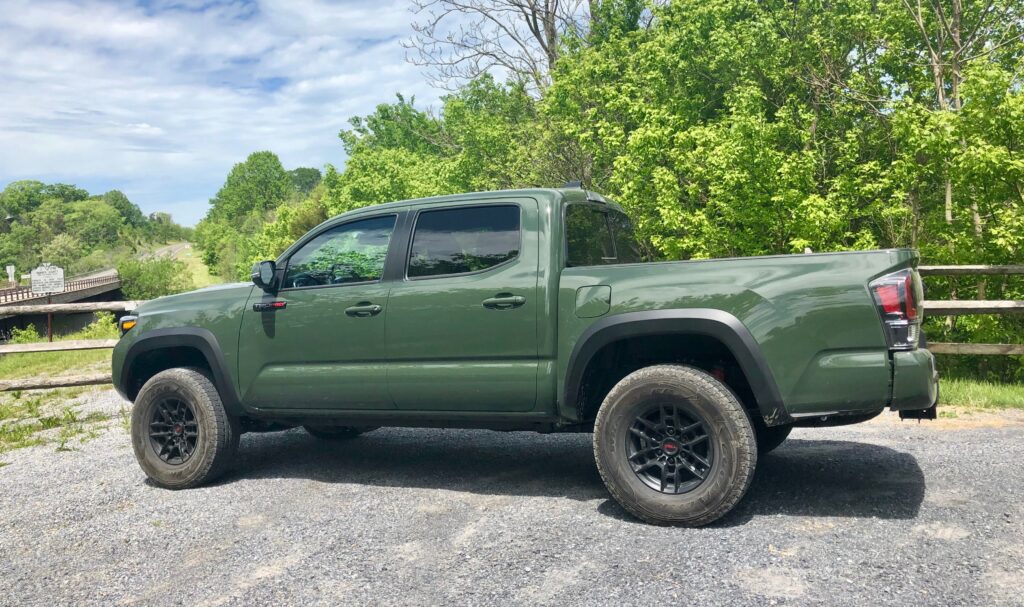
The 2020 Toyota Tacoma TRD Pro continues with the company’s tradition of powerful yet reliable vehicles. While the 2020 Tacoma isn’t a major leap in terms of technology, those small refinements can be felt. That’s why we’d recommend the Tacoma to anyone who either wants to offroad or requires a reliable daily driver.






Few modern sports cars generate as much debate as the Toyota GR Supra. Some enthusiasts still point to its collaboration with BMW, while others see that partnership for what it ultimately produced: one of the most compelling rear-wheel-drive sports cars available today.

After spending a week with the 2026 Toyota GR Supra MkV Final Edition, our conclusion is straightforward: the BMW connection does not diminish this Supra. In many ways, it helps make the car better.

Our test vehicle was particularly special. Finished in Burnout Matte Silver with a black Alcantara-and-leather interior, its window sticker showed a $73,300 total suggested retail price, including the Driver Assist Package, GT4-inspired equipment, carbon-fiber mirror caps, matte graphics, and other accessories.
What Do You Get for $73,300?
Under that long hood is the heart of the modern Supra: a 3.0-liter twin-scroll turbocharged inline-six producing 382 horsepower and 368 lb-ft of torque. Our car paired it with the six-speed intelligent manual transmission, sending everything to the rear wheels. Toyota also gives the Final Edition additional chassis, suspension and braking development intended to make this the most focused version of the MkV.

The numbers only explain part of the experience.
During our week with the Supra, what impressed us most was how usable it remained. This is a genuine performance car that doesn’t punish you for driving it normally. The inline-six delivers effortless torque, the manual gearbox adds the involvement enthusiasts increasingly struggle to find, and the compact two-seat cabin makes the Supra feel like something you wear rather than simply drive.

Push harder and its personality changes. The short wheelbase, low seating position, rear-wheel-drive layout and near-ideal weight distribution make the Supra eager to rotate through corners. Toyota originally engineered the MkV around classic sports-car fundamentals, including a very low center of gravity and 50:50 front-to-rear weight balance.
Yet you can still commute in it, enjoy the JBL audio system, heated power seats and modern driver-assistance technology, and even return surprisingly reasonable fuel economy. The sticker rates our manual Final Edition at 19 mpg city, 26 highway and 21 combined.

Yes, There Is BMW Underneath. That’s Not a Bad Thing.
Let’s address the elephant in the garage.
The fifth-generation Supra was developed in collaboration with BMW and is related to the BMW Z4. Toyota itself acknowledges that the Supra was developed in collaboration with BMW and based on the Z4 platform.

It also uses BMW’s excellent B58 inline-six architecture, and both cars are assembled by Magna Steyr in Graz, Austria.
But calling the Supra simply a “BMW with a Toyota badge” misses the point.
Toyota developed the Supra as a fixed-roof sports coupe with its own body, chassis calibration, steering character and driving mission. Toyota Gazoo Racing engineers have continually refined the MkV through motorsports and track development; the Supra has competed in Formula Drift, Super Taikyu and the Nürburgring 24 Hours.

Think of the BMW partnership less as compromising the Supra and more as giving Toyota access to one of the best modern turbocharged inline-six powertrains available.
Why This Supra May Hold Its Value
This is where the 2026 model becomes especially interesting.
Toyota is closing the chapter on the MkV with the Final Edition, and Toyota says only 1,300 Final Editions are planned for North America. That combination, Final Edition status, limited availability, 382-hp inline-six, rear-wheel drive and an available six-speed manual is exactly the formula enthusiasts tend to remember.
There is already evidence that the Supra holds value unusually well. Current iSeeCars analysis estimates the GR Supra retains approximately 76.1% of its value after five years, ranking it among the strongest luxury two-seat sports cars for resale value.

That doesn’t guarantee appreciation, and we wouldn’t buy one purely as an investment. But a low-mileage, original, well-maintained manual Final Edition has several characteristics that could make it particularly desirable years from now.
The Carsfera Verdict
The 2026 GR Supra Final Edition isn’t perfect. Visibility is limited, cabin storage is minimal, entry and exit require some flexibility, and buyers looking for four seats should look elsewhere.
But none of those things change what matters.
The Supra feels special.

For $73,300 as tested, you’re buying one of the final examples of an increasingly rare formula: a compact, turbocharged inline-six, rear-wheel-drive sports coupe available with three pedals.
BMW supplied some of the ingredients. Toyota turned them into a Supra.
And after living with it for a week, we’d argue that instead of worrying about who baked the cake, enthusiasts should enjoy a slice while they still can.
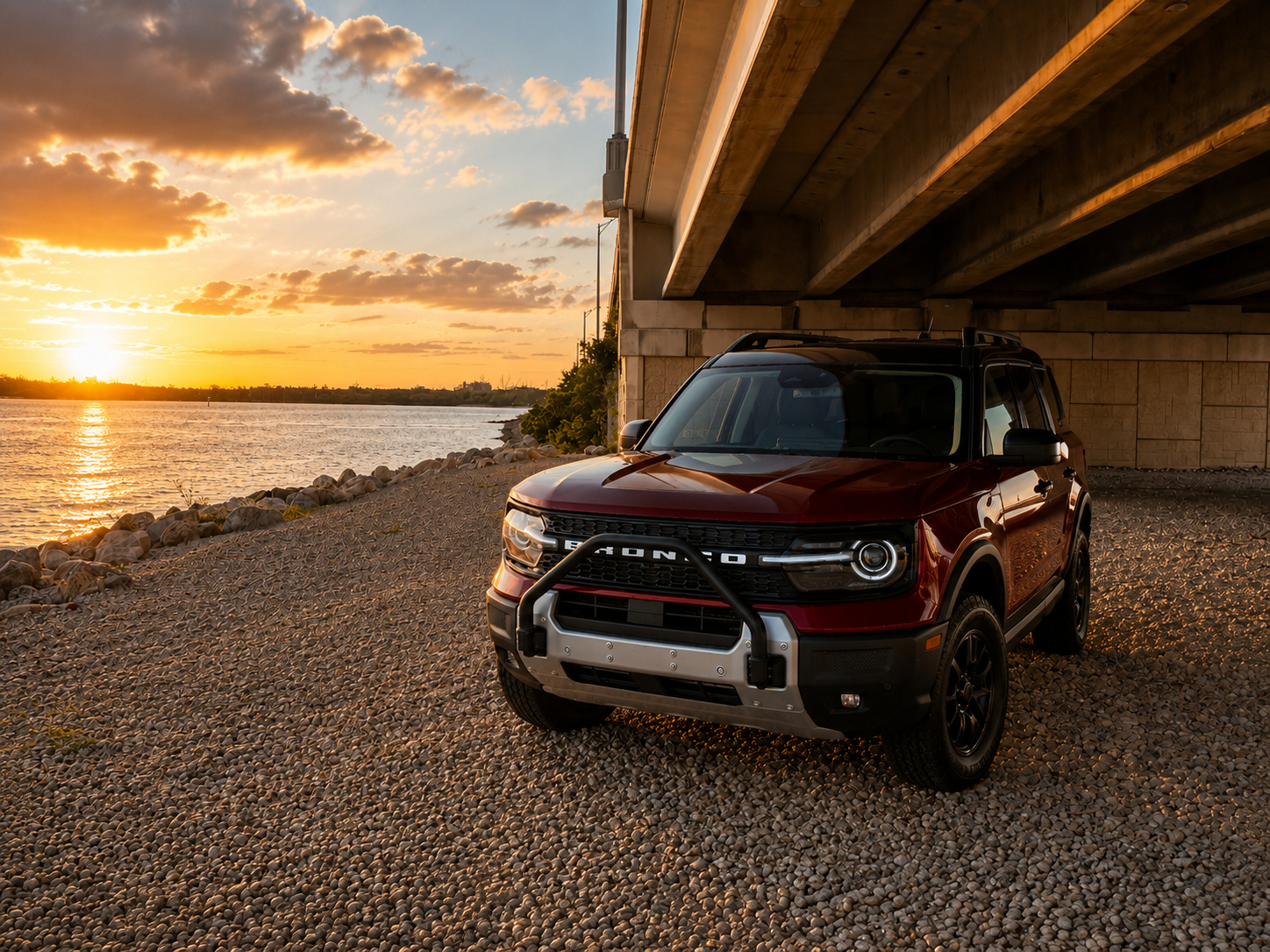
If you are considering a 2025 Ford Bronco Sport, the first thing to understand is that it offers more than rugged styling. After four days behind the wheel of a Bronco Sport Badlands, traveling between Port St. Lucie and Miami, visiting the beach, dealing with Florida’s summer weather, and attending a Shakira concert, we discovered an SUV that combines genuine capability with everyday usability.
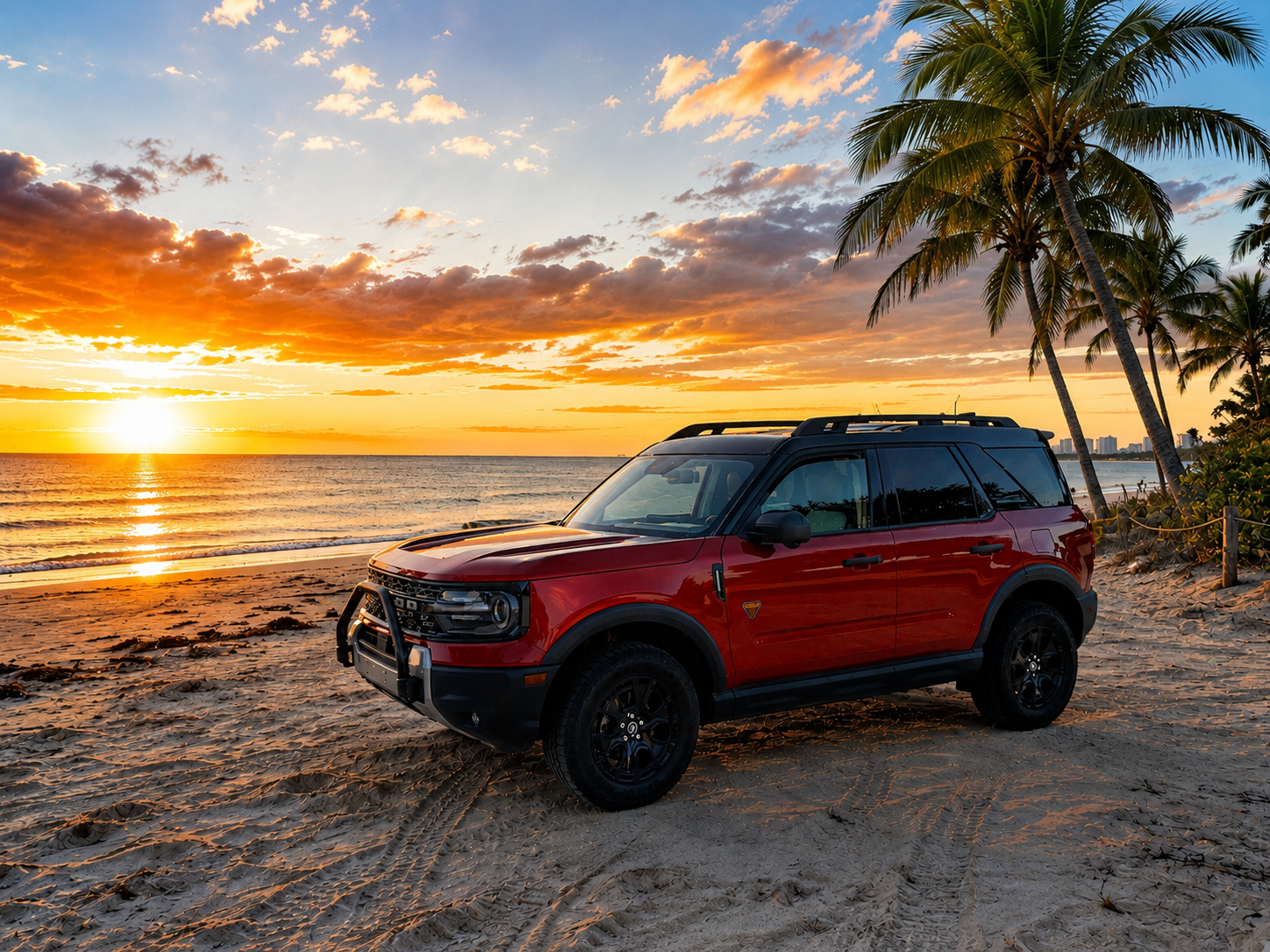
Our test vehicle arrived in Ruby Red Metallic with a Dark Space Gray leather-trimmed interior. With its squared-off body, upright stance, and Bronco lettering across the grille, it has a stronger visual identity than most compact crossovers.
More importantly, the Badlands has the performance to support that appearance.
The Bronco Sport Badlands Has the Right Engine
While most Bronco Sport trims use Ford’s smaller 1.5-liter three-cylinder engine, the Badlands receives a 2.0-liter turbocharged EcoBoost four-cylinder producing 250 horsepower and 280 pound-feet of torque. It is paired with an eight-speed automatic transmission and an advanced four-wheel-drive system.
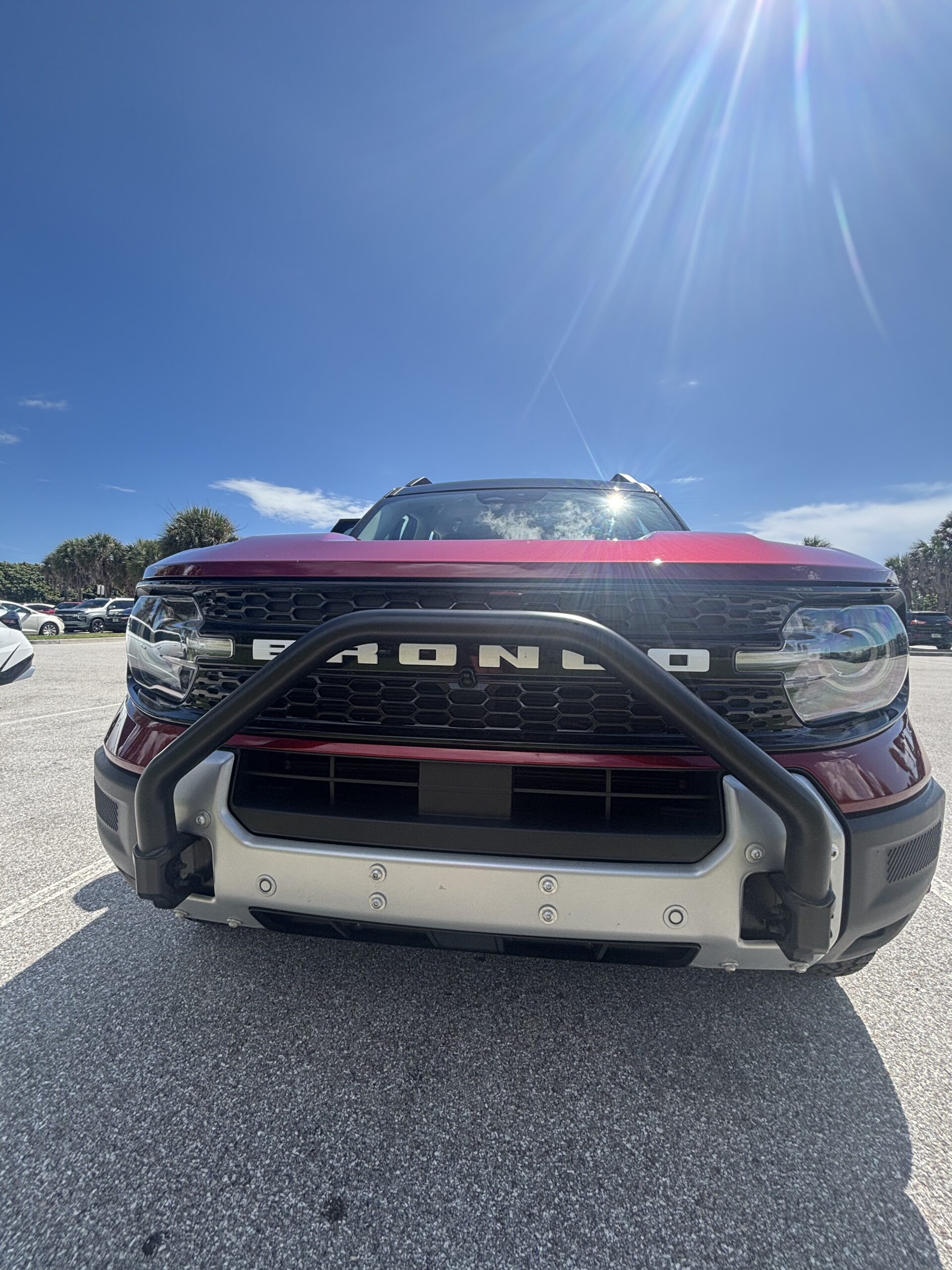
That extra power makes a noticeable difference. Highway merging feels confident, passing requires less planning, and the engine has enough low-end torque to make the Bronco Sport feel energetic despite its upright shape and off-road equipment.
The steering is easy enough for Miami traffic but still gives the driver a reassuring sense of control. Its suspension feels firm and substantial, particularly with the Sasquatch Package, but it remains comfortable enough for longer trips. Buyers should expect a slightly more rugged ride than they would experience in a Toyota RAV4 or Honda CR-V, but that firmness is part of what gives the Badlands its more purposeful personality.
Easy to Live With in South Florida
The Bronco Sport’s upright seating position and large windows provide excellent visibility. During the drive between Port St. Lucie and Miami, the seats remained supportive, the cabin was comfortable, and the Bronco Sport felt stable at highway speeds.
Its compact exterior dimensions are another advantage. It feels tougher and more substantial than many small SUVs without becoming difficult to park or maneuver through crowded city streets.
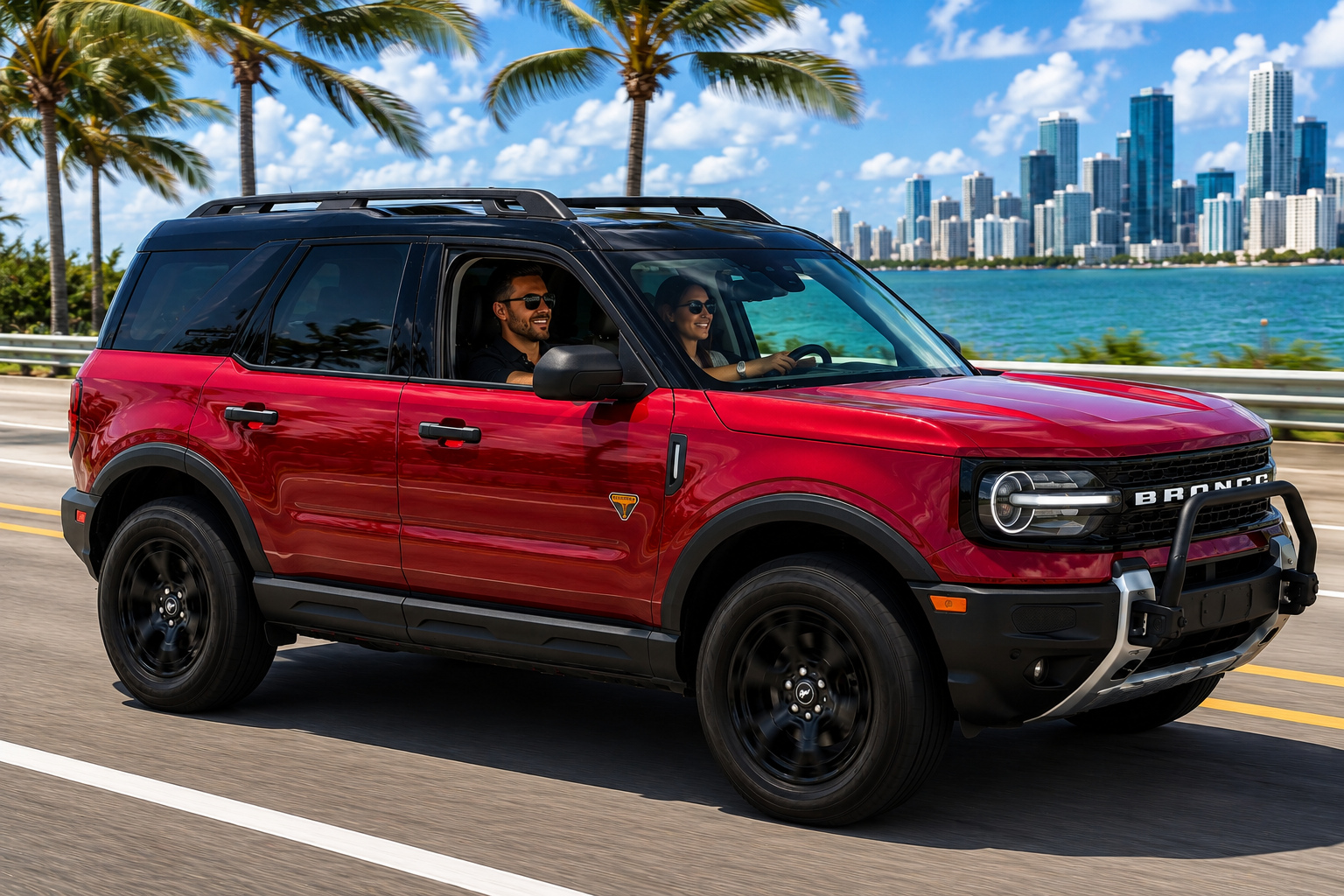
For 2025, the Bronco Sport received a major technology upgrade. A 13.2-inch SYNC 4 touchscreen and 12.3-inch digital instrument cluster are standard across the lineup, bringing its cabin closer to what buyers expect from a modern SUV. Wireless Apple CarPlay and Android Auto, remote start, multiple USB connections, and Ford Co-Pilot360 driver-assistance technology make it an easy vehicle to use every day. Ford’s 2025 update also introduced the available Sasquatch packages and additional off-road technology.
After spending the day on the highway, the Bronco Sport transitioned naturally into Miami nightlife. It may be designed for the trail, but it did not look out of place arriving in the city for a Shakira concert.
Where the Badlands Separates Itself
The Bronco Sport Badlands is not simply an appearance package. Its advanced four-wheel-drive system uses a twin-clutch rear drive unit capable of directing torque across the rear axle. It also includes seven G.O.A.T. drive modes, Trail Control, and off-road-focused 1-Pedal Drive.
Our vehicle added the $2,990 Sasquatch Badlands Package, which further emphasizes its trail capability with more aggressive all-terrain equipment and the HOSS 3.0 off-road suspension.
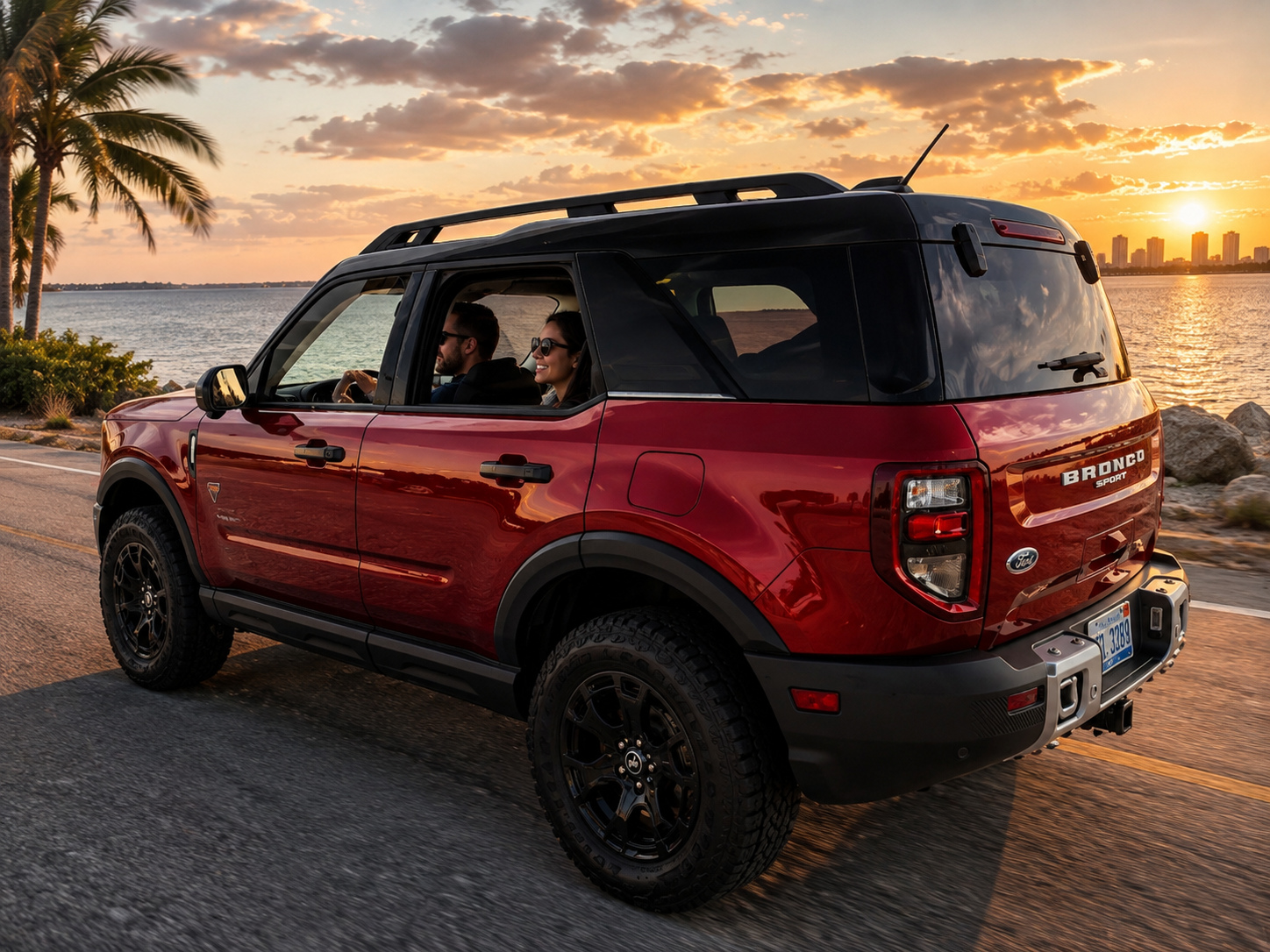
These features may be more capability than the average Florida driver needs, but they provide extra confidence when dealing with sand, muddy access roads, heavy rain, or uneven terrain.
The interior is equally suited to outdoor use. Rubberized flooring, a washable cargo area, rubber-backed rear seats, under-seat storage, adjustable liftgate floodlights, and a 60/40 split-folding rear seat make it easier to carry sandy towels, beach chairs, wet clothing, and luggage.
This is an SUV designed to be cleaned after an adventure, not protected from one.
How It Compares with the Competition
The Subaru Forester Wilderness is one of the Bronco Sport Badlands’ strongest competitors. It offers more passenger space, 9.2 inches of ground clearance, and a lower starting price of $34,995. However, its naturally aspirated engine produces considerably less power, and its continuously variable transmission does not deliver the same punch as the Bronco Sport’s turbocharged engine and conventional eight-speed automatic. Subaru’s official specifications confirm the Forester Wilderness’ pricing and ground clearance.
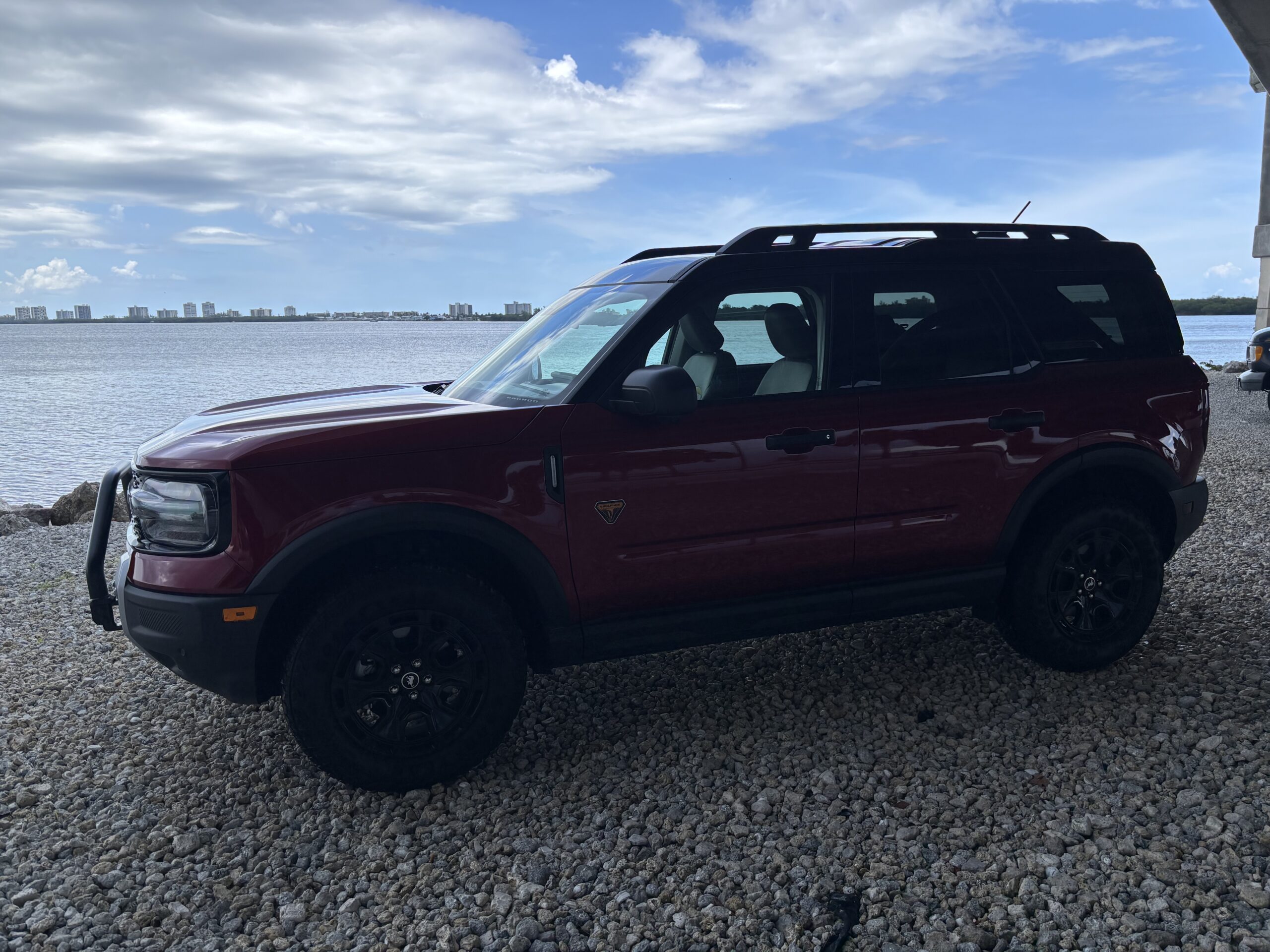
The Toyota RAV4 Hybrid Woodland Edition is the better choice for drivers focused on fuel economy. Its 219-horsepower hybrid system and EPA estimate of 38 mpg city and 35 mpg highway easily outperform the Bronco Sport at the gas pump. It also started at $36,070 for 2025. However, its electronic all-wheel-drive system and trail-focused upgrades are intended more for light off-road use than the more advanced hardware found in the Badlands. Toyota describes the Woodland Edition’s hybrid system, TRD-tuned suspension, and trail equipment here.
The Jeep Compass Trailhawk is another alternative for buyers seeking authentic off-road ability. The Jeep is capable, but the Bronco Sport counters with a stronger personality, cleverer cargo-area features, and a more modern infotainment system.
Fuel Economy and Price
The Bronco Sport Badlands is rated at 21 mpg city, 27 mpg highway, and 23 mpg combined. Those figures are reasonable for a 250-horsepower compact SUV with genuine four-wheel-drive capability, but buyers prioritizing maximum efficiency should consider a hybrid competitor.
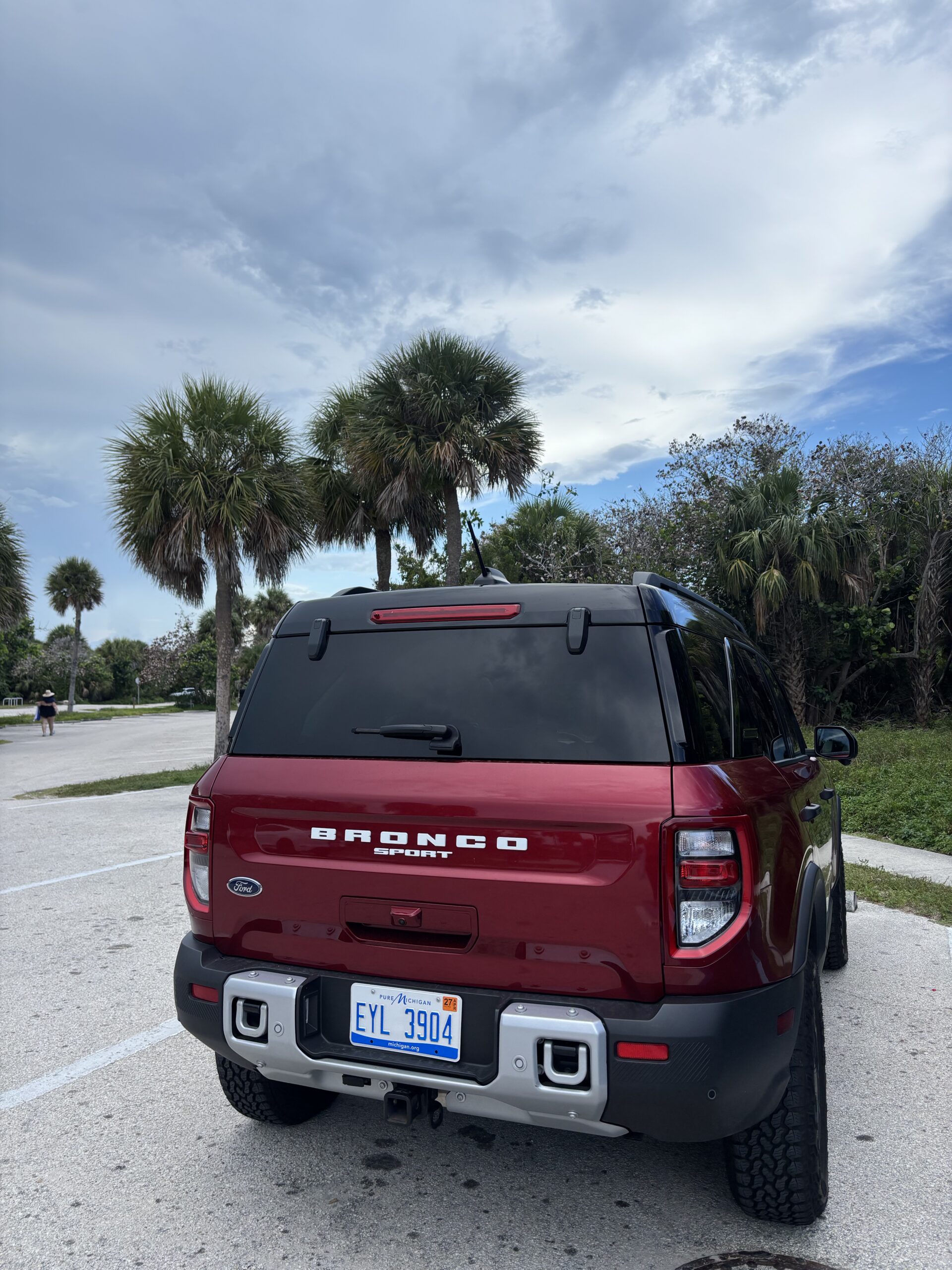
Our Badlands started at $40,115. After $5,010 in options, including the Sasquatch Badlands Package, and a $1,595 destination charge, the final MSRP reached $46,720.
Nearly $47,000 is substantial for a compact SUV. At that price, buyers should be certain they want the stronger engine, specialized off-road equipment, and distinctive Bronco character. If most of your driving involves paved roads, a less expensive Bronco Sport Outer Banks may provide a better combination of comfort, style, and value.
Should You Buy the Bronco Sport Badlands?
Buy the Badlands if you want the most powerful Bronco Sport, plan to explore beyond paved roads, or simply prefer an SUV with personality and legitimate capability. Consider the RAV4 Hybrid Woodland if fuel economy is the priority, or the Forester Wilderness if you need more interior space at a lower price.
After four days of Florida highways, beaches, summer rain, Miami traffic, and an unforgettable night with Shakira, the Bronco Sport Badlands proved that it can handle both sides of an owner’s life.
It is comfortable enough for the daily commute, compact enough for the city, practical enough for beach weekends, and capable enough for a real adventure.
The competition may offer more space, better fuel economy, or a lower price. What the Bronco Sport Badlands offers is something harder to measure: it makes even an ordinary drive feel like the beginning of a trip.
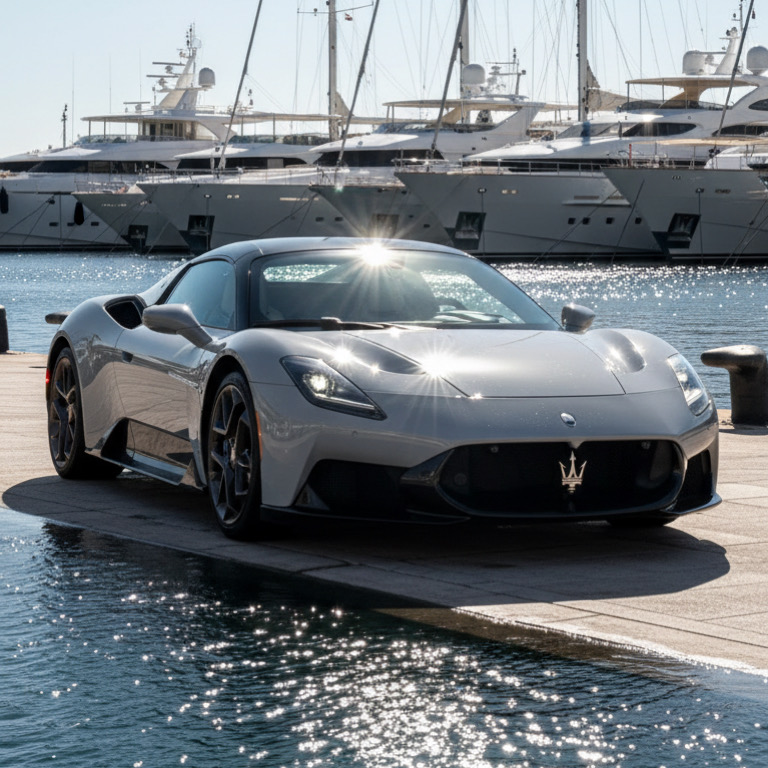
There couldn’t have been a better place to discover the personality of the new Maserati MCPura Cielo than Miami during Formula 1 weekend.
As my flight touched down at Miami International Airport, the city was already buzzing with the unmistakable excitement that surrounds Formula 1. Every luxury hotel entrance was lined with Ferraris, Lamborghinis, McLarens and Porsches. Miami becomes America’s capital of automotive passion for one week every year.
Waiting for me was something different.

2026 Maserati MCPura Cielo, finished in the elegant Grigio Incognito over an Ice Grey Alcantara interior with extensive carbon fiber trim and premium Sonus Faber audio. Configured at just over $308,000, it represents Maserati’s latest interpretation of an exotic convertible, not by copying its rivals, but by staying true to Italian grand touring heritage while delivering genuine supercar performance.
First Impressions: Exclusivity Over Flash
One thing became obvious before I even left the airport. Everyone recognizes a Ferrari. Everyone recognizes a Lamborghini. Very few recognize the MCPura Cielo. That turned into one of the car’s greatest strengths throughout my weekend in Miami.
Instead of hearing people say, “Nice Ferrari,” they walked over asking, “What Maserati is this?”

There’s something refreshing about driving a car that isn’t chasing attention.
It earns it.
Its proportions are stunning. The carbon-fiber monocoque, butterfly doors, dramatic front fascia, and clean rear design make it look exotic without feeling theatrical.
Performance That Doesn’t Need to Prove Anything
Underneath the beautiful bodywork is Maserati’s Formula 1-inspired engineering.
The 3.0-liter twin-turbocharged Nettuno V6 produces over 620 horsepower, sending power to the rear wheels through an eight-speed dual-clutch transmission.

Numbers only tell part of the story. Unlike several competitors that feel brutally quick but emotionally distant, the MCPura Cielo communicates with the driver.
Throttle response is immediate. Steering feels incredibly precise. The chassis constantly tells you what the front tires are doing. Even through Miami traffic, there was a remarkable sense of connection that many electrically assisted supercars have started to lose.
Miami Became My Test Track
Most automotive journalists evaluate supercars on race tracks. I believe luxury buyers spend 95% of their time on real roads. Miami proved to be the perfect environment to understand what this Maserati is actually built for. From downtown traffic to the causeways, from Ocean Drive to Brickell, the suspension remained surprisingly compliant.

Visibility is better than expected. The dual-clutch transmission behaves smoothly at low speeds. Unlike some exotic cars that constantly remind you they’re race cars with license plates, the MCPura Cielo is surprisingly approachable. That’s exactly what makes it such a compelling alternative to its competitors.
Sunrise: Where the Cielo Truly Comes Alive
The defining moment came just before sunrise.

With the retractable roof open, Miami’s warm ocean breeze entering the cabin, and the first rays of sunlight reflecting across the Grigio Incognito paint, I finally understood why Maserati named it Cielo.
“Cielo” means sky.

This isn’t simply a convertible version of the coupe. It’s an entirely different experience.
Without a roof separating you from the engine, every acceleration becomes more immersive.
The Nettuno V6 doesn’t produce the deep thunder of a naturally aspirated V12.

Instead, it delivers a sophisticated mechanical soundtrack that’s unmistakably Italian.
That sunrise drive reminded me that performance isn’t measured only in acceleration.
It’s measured in emotion.

Wynwood: Automotive Art Meets Street Art
Later that afternoon, I headed toward Wynwood.
This became one of the most memorable photography sessions I’ve ever experienced.
Wynwood has always celebrated artistic expression.

The MCPura Cielo fits perfectly into that environment because it doesn’t feel engineered solely by computers. It feels sculpted.
The flowing body lines, dramatic air intakes, and elegant proportions looked like another piece of art against Miami’s colorful murals.

Several people stopped not because it was the loudest supercar there, but because they had never seen one before.
That’s exclusivity.
Calle Ocho Shows Another Side
Perhaps the biggest surprise happened on Calle Ocho. Most supercars feel uncomfortable outside luxury neighborhoods. The Maserati didn’t. Families smiled. People asked questions. Children pointed at the Trident.

Unlike brands that project intimidation, Maserati projects elegance. That emotional connection matters. Because buying a $300,000 automobile isn’t simply about specifications.It’s about how the car makes you feel every time you drive it.
How Does It Compare?
After spending several days behind the wheel, I couldn’t help comparing it with today’s exotic market.
The Ferrari 296 GTS is faster and more track-focused.
The McLaren Artura Spider feels lighter and incredibly clinical.
The Lamborghini Temerario is louder and more dramatic.
The MCPura Cielo occupies a completely different space.

It combines supercar performance with genuine luxury, everyday drivability, and Italian craftsmanship in a way few manufacturers still pursue.
Rather than trying to dominate every specification sheet, Maserati focused on creating a car owners genuinely want to drive. Every day.
Carsfera’s Verdict
The 2026 Maserati MCPura Cielo isn’t designed to win comparison charts. It’s designed to win hearts. During Formula 1 week, surrounded by some of the world’s greatest supercars, it never felt overshadowed. Quite the opposite.

Its rarity, elegant styling, balanced chassis, and unmistakable Italian character made it one of the most interesting cars I experienced all weekend. Miami simply confirmed what Maserati already knew. Performance attracts attention. Character creates memories.
The MCPura Cielo delivers both, and that’s exactly what makes it one of the most compelling exotic convertibles on sale today.
-

 TEST DRIVES2 months ago
2026 Maserati MCPura Cielo
-

 NOW TRENDING2 months ago
2027 Range Rover GT Debuts as the Brand’s Lowest EV
-
 NOW TRENDING2 months ago
Mercedes-AMG Admits the C63 Hybrid Was a Mistake for Buyers
-

 INTELLIGENT MOBILITY2 months ago
2027 Toyota Crown Gets New Hybrid System and Fresh Design
-

 NOW TRENDING2 months ago
Next-Gen Cadillac CT5-V Blackwing Could Keep the V8 Alive
-
 NOW TRENDING2 months ago
Honda Civic Si Production Ends After 2026 Model Year Pause
-
 NOW TRENDING2 months ago
Rolls-Royce’s $32 Million Droptail Took 9 Months of Handcrafted Woodwork
-
 NOW TRENDING2 months ago
2027 Toyota Sequoia Adds Trailhunter Package and New Tech
You must be logged in to post a comment Login